
Case Study: Mill Quality Inspection
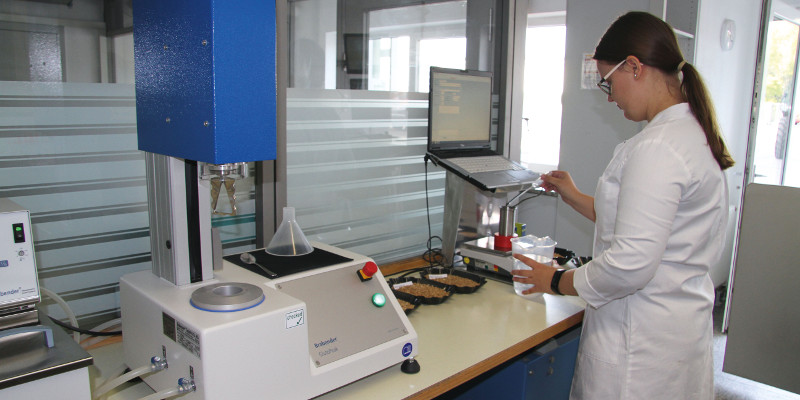
In the milling industry, being able to determine the quality of raw materials is fundamental. Being able to test them is an essential task. Wiesneth Mühle GmbH in Franconian Pommersfelden, Germany, has improved its quality management by introducing a time-efficient system.
by Markus Löns, Brabender GmbH & Co. KG
In what is one of Bavaria’s largest flour mills, constant thorough inspections in the in-house laboratory are of the utmost importance for maintaining the company’s quality demands. Therefore, before vehicles arriving at Wiesneth Mühle GmbH’s yard in Pommersfelden-Sambach from the agricultural operations in the region are permitted to continue to the incoming goods area, quality inspections must first take place. A sample of the grain delivered is taken directly from the vehicle and transferred to the laboratory facilities via a pipe system.
Here the grain received is ground and its gluten quality is examined. The GlutoPeak, a quick method developed by Brabender, the Duisburg-based specialists for laboratory measurement equipment, is used for the purpose. Within a maximum of 10 minutes, including preparation and cleaning, the equipment provides information on the respective grain’s gluten properties and structure – a saving when it comes to a complete quality analysis of incoming goods. Every day, Wiesneth Mühle mills around 250 tonnes of wheat and rye. In summer, the vehicles belonging to the supplying farmers stretch in a queue way beyond the mill’s gates. A wide variety of other types of grain can also be recorded at two other sites in Nuremberg and Würzburg.
High Quality Demands
“The quality of our products plays an enormous role in our customers’ satisfaction,” explains Julia Wiesneth, one of current mill owners. She is part of a long family tradition in the miller’s craft. The Wiesneth Mühle, ideally situated on the small Reiche Erbrach river, was first mentioned in official documents in the 13th century. For more than 300 years, it has been in the possession of the Wiesneth family, who are highly regarded across the region for top quality, reliability and flexibility.
“Consistency and thoroughness are an absolute must when it comes to the quality demands made of our flours. Our focus is on the inspections and analyses carried out right at the start of the process, when we receive the grain. In this respect, last year we considerably optimized and improved the possibilities for qualitative laboratory tests by acquiring the GlutoPeak. We liked the idea of quick, simple laboratory tests and the fact we are able to deploy it when receiving grain deliveries, so we can assess the different varieties’ properties.”
The EU’s Fertilizer Regulation, which comes into force this year, also played a role in our decision to invest in the GlutoPeak: “In this framework, we are counting on falling protein values, and therefore want to compensate for this by using the special properties of certain types, to continue to guarantee consistent top quality,” explains Julia Wiesneth.
Consistency
The Brabender GlutoPeak comes into use even before beginning analytical differential diagnostics, using the three Brabender devices: the Farinograph, Extensograph and Amylograph. This procedure, with its three-Phase-System, is comparably time-consuming, and requires trained lab personnel. For this reason, only random sample-based analyses have been possible until now, upon arrival. Procedures changed with the acquisition of the GlutoPeak, in 2016: “The Brabender GlutoPeak means for us essential support for recording type-based quality. In this manner we can obtain rapid information that can also be used for estimating protein ratings, for making rheological statements about the gluten properties and structure, and therefore making a qualitative assessment of the grain being examined,” says Julia Wiesneth.
For many types of wheat and mixes, being able to determine the protein and gluten content alone is often not enough to be able to make rheologically valid statements on the expected baking properties. The Brabender GlutoPeak closes this gap, and its consistent monitoring of the goods received provides security. Wiesneth Mühle’s motto is fitting in this respect: “Monitoring provides security”. It engenders trust in the company’s customers, who span baking businesses of various sizes, specialist wholesalers for bakeries and confectioners, as well as pizzerias.”
Rapid, Reproducible Quality Controls
For such customers, determining the quality of raw materials plays a crucial role in the search for the optimum quality. In a matter of minutes, the GlutoPeak process provides a ‘rheological fingerprint’ of the wheat flours, spelt flours and other grain-based products produced by Wiesneth Mühle. The measurement-taking is based on the separation and subsequent aggregation of the gluten in a flour-water suspension. The energy input during the dough-forming creation of a gluten network is depicted by torque curves. This enables conclusions to be drawn on the gluten quality and its specific features, which the GlutoPeak process documents.
Luisa Wiesneth, who is responsible for the lab, explains, “Gluten quality is a decisive quality criterion when it comes to assessing baking properties. Not only must this take place as quickly and simply as possible: above all, it must be able to be reliably reproduced for quality management purposes.” Like her sister, Luisa is also a young miller, and since achieving her qualification from the Chamber of Crafts, is entitled to label herself “Germany’s best miller 2015/16”. She stresses the importance of the Brabender GlutoPeak for complete quality assurance: “In the received goods section, the rapid, non-manual implementation of the lab test using the GlutoPeak offers a time-saving alternative to manual washing methods that are often bound up with errors.” The only work carried out by hand is the weighing of the sample. Software then controls measuring and analysis fully automatically.
The GlutoPeak Process
In a suspension comprising a 3-10 g flour or coarse meal sample and distilled water, the GlutoPeak measures the aggregation behavior of the gluten proteins gliadin and glutenin. At a constant speed, the equipment separates the gluten complex, before aggregating it to a characteristic network, which is then broken down by the rotation of a mechanical measuring paddle. As this occurs, energy inputs are measured: the behavior over time and torque curves for the physics of the gluten are recorded and graphically displayed by the software as curves.
Decisive is the time taken to reach the maximum point on the curve, the peak, as well as its height and subsequent decline of the curve. In just the shortest time, these values, which can easily be read at a glance, provide the essential information on gluten quality and its rheological properties. Strong gluten generally shows short rise times with high peaks; soft gluten can be recognized by delayed, flatter curve peaks and very soft gluten shows very flat curves with very late and low peaks, right up to ‘zero peaks’, as is typical of wheat used in biscuits and waffles. A benefit compared to other systems, which extract gluten, is the characterization of wholemeal flour. With the same grain, various series of tests, along with their results, showed a good correlation between wholemeal flour and typical bread roll flour.
“When using the GlutoPeak for analysis, your glance first falls on the ‘Time of maximum torque (BU)’ and ‘Maximum torque (BU)’ values. However, day by day we have come to learn that viewing the entire curve – under consideration of all measurement values – is extremely important for the evaluation,” explains Julia Wiesneth. The development of the company’s own parameters, in order to be able to evaluate the region’s products as well as possible, concludes the process.