
Frozen Products in the Pacific
Frozen foods rely on attractive packaging for being chosen among other options in the freezer.
Let’s be honest, dough does not look its best when unbaked. It is pale and soft, and doesn’t smell good like freshly baked goods. That’s why the majority of frozen pies, pastries, and other dough products are packaged in cardboard boxes with no transparent windows. As a rule, a very small percentage of producers risk transparent windows. Those that put their unbaked products in transparent bags with only essential information printed directly on the bag are either (a) not making an effort, or (b) believe their products need no story supporting them. Most manufacturers, however, are aware of the power that good design has over buyers. And what better way to lure a hungry buyer than to show them a picture of a perfectly-served meal?
Generally, we can divide pastry in the frozen aisle into salty or sweet. We can also categorize them by their packaging type. These are, in most cases, basic transparent bags, used only for protection and basic information, and cardboard boxes or sealed printed foils. Western-style frozen bakery products are generally available in fully covered packages. Asian style products can be found both in transparent and in fully covered packaging. Let’s analyze some of the popular brands in the Pacific region.
Sara Lee
One of the largest frozen food manufacturers present in Australia and New Zealand, Sara Lee, bases the visual identity of product packaging on the brand mark. In the case of Sara Lee, this is a smart choice, because the brand is well-known and consumers perceive its global presence as a sign of proven quality. The logotype, consisting of white, bolded script letters on a red ribbon with golden accents, is designed to look traditional in a bid to position the brand as a reliable, safe choice. The package is designed in a much “lighter” fashion. The basic color for all ranges is white. Box fronts are divided into three horizontal blocks, the first block being reserved for an attractive product photo, the central field a red ribbon containing the brand mark, while the bottom field is white and reserved for the name of the product written in large, elegant serif typography. An additional touch is the color of the letters, taken from the most dominant shade in the product photo, creating a well-rounded composition.
Western-style frozen bakery products are generally available in fully covered packages. Asian style products can be found both in transparent and in fully covered packaging.
Patties Foods
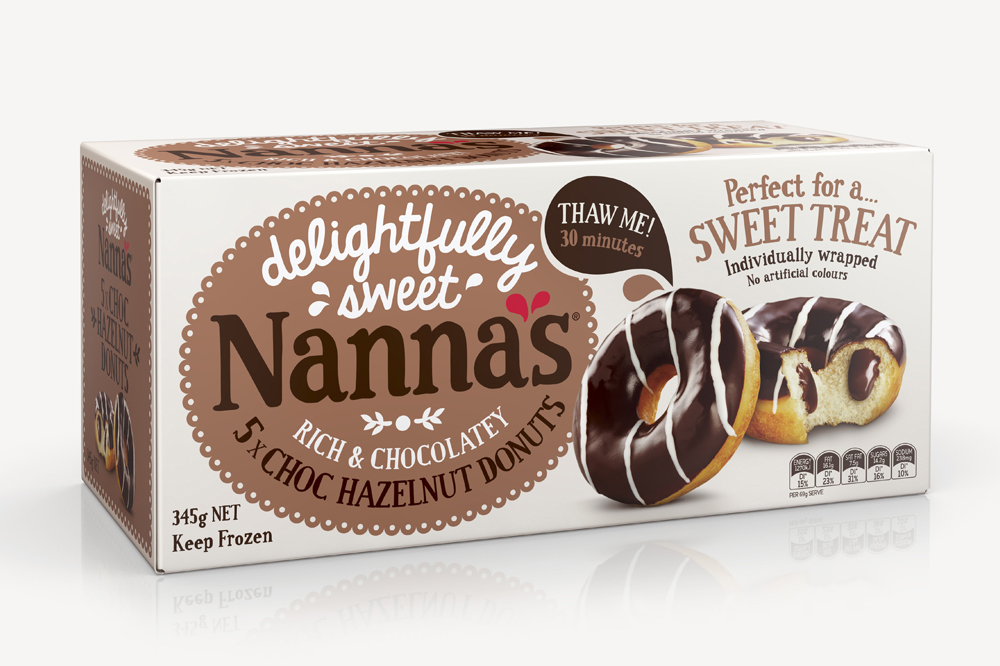
In 2015, the redesign of another Australian brand of frozen desserts was acknowledged by The Design Society, which also brought it coverage in all the main publications. Even more important, product sales improved as a result of this carefully considered and applied redesign. Prior to the new packaging, Nanna’s had been just another frozen dessert brand. With the help of Brand Society, an Australian branding agency, the product was repositioned as a refreshing novelty in the frozen foods aisle. How did they do this? During the research phase, they focused on nostalgia and the emotion connected with the brand’s name. In the drawing phase, the designers combined elements from “yesterday” – a doily with strong colors, playful lettering, and a few simple graphic elements, making the brand contemporary in this way. The name itself is huge and takes up almost the entire front of the packaging, which is ideal for instant recognition. They included an appetizing photo of the product inside, but only as an additional attractive visual element.
“The great Australian taste” of Patties Foods, owner of the above-mentioned Nanna’s, owns additional sweet and salty brands of frozen pies and pastries. Each of these specializes in a particular niche. The Patties range offers quick finger food solutions; Herbert Adams offers more exclusive gourmet pies and pastry, while Four’N Twenty offers the best everyday solutions. All ranges are branded according to their character and deliberately designed to look entirely different from one another. For example, the gourmet pies of Herbert Adams emphasize luxury through an elegant color palette and a gold logotype in the form of a signature for the brand mark. The step from “mass” to “gourmet” was made by the Brand Society, which once again proved a valuable partner for bringing the brand to the next level. They also created a redesign for Four’N Twenty, refreshed the brand mark, used its strong appearance and colors as a primary element to create a distinction among other products in the freezer and updated the overall look of the packaging.
New Zealand – Edmonds
The food market in New Zealand is connected to the Australian market and many Australian brands can be found on New Zealand supermarket shelves. In the freezer sector, major brands like Sara Lee and Nanna’s can regularly be found. Of course, New Zealand has its own beloved manufacturers, too. Edmonds, one of popular established Kiwi brands for “all things baking” and famous for its cookery books, has a frozen Edmonds Lemon Meringue Pie that looks extremely attractive, primarily due to the yellow, sunny logotype and brand colors of the packaging that stands out among other frozen products.
Singapore
In Singapore, a melting pot of many cultures and cuisines, frozen aisles are filled with American-style pancakes, English waffles and Korean and Asian style pancakes, buns and mantous. Aunt Jemima, American manufacturer “all for pancakes” has a frozen breakfast line that consists of different pancakes, toasts and waffles. The entire range uses one shade of red that dominates the package. The logotype is large and written in white letters with an illustration of a black woman, presumably, the generic representation of “Aunt Jemima”. Product names vary significantly, depending on the product. Product photography is used to illustrate the content of the package, but it is a secondary element used only for quick recognition.
Crêapan, a Belgian brand of frozen pancakes and a direct competitor of the aforementioned Aunt Jemima, is designed to look more appealing and contemporary. Packages are white, with photos of tasty-looking products as the main selling point. All other information is placed in a single, colored vertical box on the left side of the package. Asian-style products like mini mantous and a variety of small buns made by New Moon are generally placed in transparent packages. New Moon, a Singaporean food brand, packages frozen buns in simple plastic foil. To prepare them, the consumer steams them and the finished products have a similar color and texture as when they are frozen. When pastry that is meant to be baked is placed in transparent packaging it looks pale and unfinished, because the finished product differs in color and texture from the packaged product. This is why most of the packages are not transparent.
Malaysia
Figo Foods is a Malaysian food company specializing in halal frozen food. It was established in the late 1980s and became one of the major players in the local market. It has an extensive range of frozen products. A range of mini mantou that comes in three flavors is a typical example of frozen Asian-style packaged products. Of course, there is more than one packaging solution present in the market, but many frozen mantous and buns are packaged in simple bags printed in only one color, and each flavor usually has a signature color. Bags are also completely see-through or partially transparent, which is the case for Figo mini mantous.
KG Pastry, owned by Kawan Food Berhad, is the largest brand of traditional Chinese frozen pastry in Malaysia and packages filled mini buns in separated transparent “pockets”, using the products as an element of primary visual appeal. Branding is placed on a sticker where all elements – illustration, name, additional information and even a large table of ingredients – are placed on the same side of the package.
At a glance
In conclusion, Australian and New Zealand markets are mature and design elements play an important role in positioning a brand and helping it grow. By making use of Brand Society and its expertise, Patties Foods repositioned its brands and made them visually attractive and highly desirable for consumers, regardless of the specific type of product. The same philosophy is applied to everyday pastry and gourmet pies, because the goal is the same: attract more consumers. Other Pacific markets can learn from these examples. Here, frozen foods again prove to be an important part of consumers’ lives. They want to be able to enjoy a nice meal with as little fuss as possible. And what better way to have exactly that, than to stack your freezer with nice looking, tasty pies and pastry, ready to enjoy after only a few minutes’ preparation.