
Elżbieta Zajezierska, President of NOWEL: “Good bread still needs time – even in the most modern bakery”
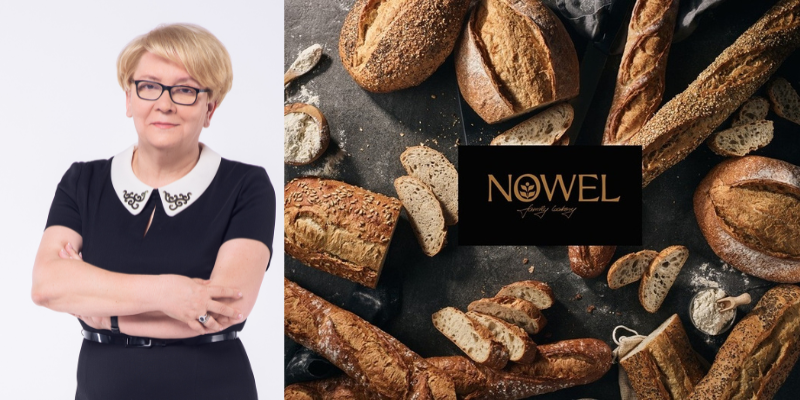
NOWEL is a family bakery founded in 1925 in Leoncin, near Warsaw. NOWEL specializes in the production of bread for baking and is one of the leaders in this category in Poland. Its products are sold to the largest retail chains and to customers in over 30 countries. State-of-the-art production facilities in Europe, its own Research and Development Center, and strategic investments in logistics and energy efficiency allow it to combine large-scale production with a craft approach to taste and quality. In 2025, NOWEL joined the Polish Association for Sustainable Agriculture and Food, strengthening its commitment to a responsible supply chain.
We interviewed Elżbieta Zajezierska, President of NOWEL, about the how the company is preparing for the next 100 years, what they prioritize and what they are mindful of when they look at the world right now.
How would you describe NOWEL today?
When I look at our company, I see continuity and consistency above all else. We’ve started as a small artisan bakery in Leoncin near Warsaw, and today – a hundred years later – we are one of the leaders in the bake-off category in Poland and are expanding sales in over 30 markets around the world. The scale has changed, the technology has changed, but the way we think about bread has remained the same: quality first, then everything else.
Very early on, we made the decision to specialize entirely in bake-off bread, and that was a turning point. Today, exports account for about 30 percent of our production, and the new plant in Nowy Modlin has given us the space to grow further and respond quickly to the needs of our trading partners. Our own Research and Development Center cannot be overestimated. This is where we combine craftsmanship with technology – traditional fermentation processes with data analysis and product design tailored to specific customer needs. An equally important element of our development is maintaining the highest standards of quality and production safety. We regularly undergo audits by our trading partners and system audits, and our plants have international BRC and IFS certificates, which are among the most demanding standards in the food industry.
The Polish bakery market is considered very demanding. What makes it unique?
Poland is a country with an extremely strong bread culture. It is one of the largest bread markets in Europe – there are nearly 8,000 bakeries operating here, and the entire sector accounts for about 20% of all companies in the Polish food industry. At the same time, modern sales channels are growing very dynamically – discount stores and convenience chains, which are currently among the fastest growing in Europe. We also have a great attachment to fresh bread, which is why the development of the bake-off category has been more of an educational process than just a business one from the very beginning. On the other hand, Polish consumers have changed a lot. Today, they expect quality, consistency, all-day availability, and simple ingredients. This is where bake-off bread shows its real value as a modern model of freshness management, while reducing product waste. This is particularly important in the context of the scale of food waste – according to Eurostat data, more than 58 million tons of food are thrown away annually in the EU, with a significant proportion of food waste by households in Poland coming from cereal and bakery products.
What operational challenges do you face today as a producer?
We have always viewed production as a single coherent ecosystem – from the field to the store shelf. That is why it was so important for us to join the Polish Association for Sustainable Agriculture and Food in 2025.
The quality of bread starts with the quality of the grain, and the stability of the raw material is now one of the key elements of business security. The second significant change was logistics. Our plant in Nowy Modlin was designed by us from scratch, which made it possible to connect it to the NewCold warehouse with a technological bridge. Pallets with bread are transported from production to the warehouse automatically, without the need for road transport. This means a reduction in transport costs of around 30% and
a decrease in emissions of approximately 1,300 tons of CO₂ per year. This is not just an investment in efficiency – it is a change in the operating model of the entire supply chain.
How have inflation and energy costs affected your strategy?
The bake-off model and long-term contracts with retail chains give us the comfort of planning well in advance. This allows us to limit the impact of short-term price fluctuations. At the same time, we have been investing in energy efficiency for years – technological heat recovery, renewable energy sources, and media consumption monitoring. This allows us to stabilize costs and build stable relationships with our partners.
The shortage of workers is a problem throughout Europe. How does it look at your company?
At NOWEL, technology does not replace people – it supports them. We automate repetitive and physically demanding processes, but it is always the experience of our bakers that is the foundation of the quality we offer. We have people in our company who have been working with us for decades, often entire families. We also focus on education and cooperation with academic centers to give young people a real alternative in the process of planning their careers. We therefore have representatives of three generations of employees on board, which is a great commitment for us and a source of pride.
In what direction are you investing today?
We are building scale, but with flexibility in mind. We have the space and infrastructure ready to install more production lines, and we are intensively developing R&D and the digitization of production planning. We want to become an even closer partner that not only supplies the product but also co-creates the category with any retail chain – from concept to logistics.
At the same time, we are working very intensively on solutions in the area of sustainable development. In recent years, we have implemented a number of initiatives related to energy efficiency, process energy recovery, and optimization of raw material use. Another important step was the introduction in 2026 of raw materials sourced from regenerative agriculture, including flour produced from wheat grown in a way that supports soil restoration, biodiversity, and long-term supply chain stability.
What role does export play?
Exports are one of the pillars of our development. Currently, our bread is available in 30 markets around the world, and we are constantly working on expanding to new ones. Poland as a production base gives us a huge advantage – a central location in Europe, modern infrastructure, and highly skilled teams. This allows us to combine quality with efficiency and speed. Poland is one of the largest food producers in the European Union and one of the key exporters of agri-food products – in 2025, the value of exports reached a record level of EUR 58.4 billion. This creates a very stable raw material and logistics base for the development of modern baking.
Where do you see the greatest market opportunities?
The premium segment, high-quality private labels, and convenience solutions. Today’s consumers are looking for freshness, quality, and simplicity of preparation – and this is exactly what the bake-off model offers. This is also evident in market data – in Europe, the share of private labels in food sales has already reached around 38.1%, and in many categories it is growing thanks to cooperation between retail chains and specialized producers. At the same time, the premium and clean label product segment is developing dynamically, which is currently one of the fastest growing categories in bread.
At NOWEL, we are seeing this trend very clearly. Our premium stone-baked products, based on traditional fermentation processes, using sourdough and longer dough preparation times, are very popular. On the other hand, the convenience segment is also growing rapidly – for example, in the hot dog bread category – which responds to the needs of fast food and modern retail.
We are also seeing new directions in the development of functional bread – high-protein products, rich in fiber, or responding to the needs of specialized diets, such as keto or low-carb. These trends show that bread remains an extremely dynamic category, susceptible to innovation.
What will determine the success of bread producers in the coming years?
The companies that will win are those that think about bread holistically – from the soil, through technology, to the consumer experience. The future of baking is not about choosing between tradition and modernity. It is about combining them in a smart way.