
Schubert’s New Cobot Is a Fast Learner
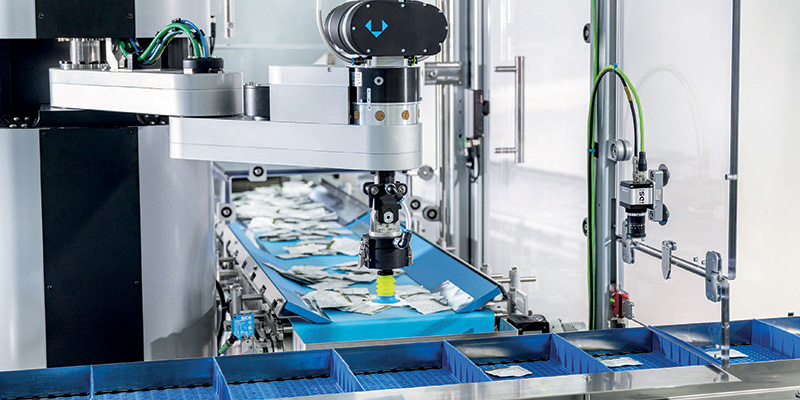
Schubert, the packaging machine manufacturer announced their first cobots are already being tested by customers for the automation of infeed processes. According to the company, the use of image processing with underlying artificial intelligence makes the new cooperative robots from Schubert extremely flexible and exceptionally easy to program.
The packaging machine manufacturer has a new milestone in sight with its cobot, called ‘tog’. For the first time ever, Schubert cobots automate simple manual processes outside of the highly efficient machine sequences and can be adapted to new tasks very quickly without requiring any programming knowledge. Ralf Schubert, managing partner of Gerhard Schubert GmbH, describes the rationale: “We developed the tog.519 for pick & place applications with lightweight products, where previous cobots would be out of their depth.” The tog simplifies and accelerates packaging processes even further: “With one of our cobots, manufacturers will be able to react much more flexibly in the future to changing market situations and requirements,” explains Schubert.
Key advantages: fast and extremely user-friendly
A high working speed and remarkably simple operation are essential to deliver this extraordinary flexibility. Ralf Schubert asserts, “Our cobot has one of the world’s fastest capabilities for ‘gripping from disorder’.” To ensure speed throughout, it makes sense to use a protective cell when space is limited. However, the Cobot also offers the ability to operate without a protective cell while maintaining a high level of safety. When operating as a free-standing robot, the Schubert cobot does not work directly together with humans (collaborative). But it does work in an environment with them. Such cobots are referred to as cooperative or coexistent and call for a very different safety concept. “To achieve this, we used image processing to actually teach the cobot how to see,” adds Schubert. “This way, when approached by employees, it gradually reduces its speed until it comes to a complete standstill.” It is only through the vision system that the fast cycle rate is possible when reaching into disorder or for the simple adaptation to new tasks.
Artificial intelligence as a technology driver
The prerequisites here are provided by a neural network with artificial intelligence (AI) developed in-house by Schubert, which precisely matches specific industry requirements in terms of safety, speed and programming. To program a specific product, the network is trained using product photos in the Schubert Cloud and then loaded onto the cobot as a format. To reliably recognize new products, the AI only needs a handful of images and three days’ time. “We are making the learning process so simple that our customers will be able to create new formats and products themselves in the future without having any prior knowledge of image processing or programming,” confirms Ralf Schubert. Via the HD camera system integrated into the cobot, the AI then decides how the cobot should proceed.
The company announces that an entire family of cobots will follow in the coming years. A complete modular system for cobot solutions has been defined as the goal, comprising five-axis Scara kinematics, a vision system, infeed belts, format parts and much more. Key areas of application are in the food sector, as well as in cosmetics and pharmaceuticals. High volumes can also be processed in kit assembly, where different products need to be combined into a single kit, or in product finishing.