
SICK Announces Major Upgrade to Color Sensor Portfolio
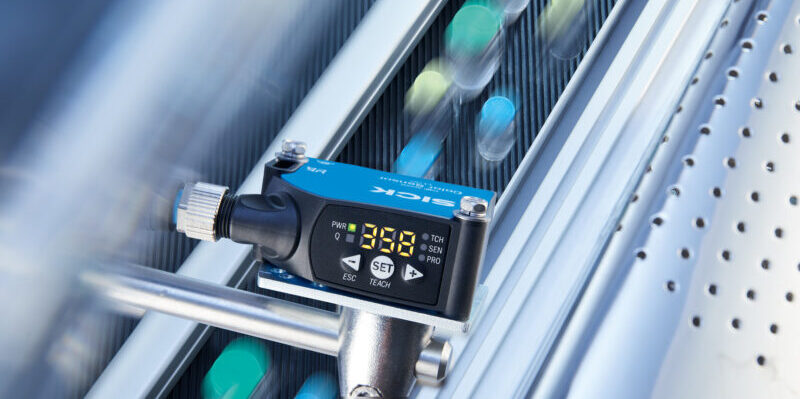
SICK announces a major advance in its color sensor portfolio, with the launch of its CSS and CSX high resolution and high-speed devices. SICK’s newly developed flagship CSS color sensor leads the way with best-in-class color resolution and the ability to distinguish even the slightest nuances in shade. Its capability to identify subtle differences in surface structures and textures opens up wide-ranging applications in food and drink manufacturing.
The SICK CSS color sensor detects colors precisely, regardless of the distance from the object, at lengths of up to 500mm. Its unique distance regulation capability dispenses with the need for strict guidance of the target. It therefore accommodates changing sensing distances automatically on a production line, e.g. to account for differing orientations of a product on a conveyor, and to handle varying object sizes with ease.
Live On-sensor Values
Live L*A*B* or RGB color values are displayed directly on the CSS’s on-sensor full-color display. An innovative teach-in method enables the sensor to assess the similarity between the detected color and expected color in real time. Up to 15 colors can be output directly via the sensor’s four switching outputs. The SICK IO-Link CSS color Sensor also offers the unmatched capability to output up to 24 colors to a machine controller. The SICK CSS goes far beyond sensing homogenous colors, opening up a wide field of applications, and is an even an attractive alternative to expensive color measurement devices, in some cases.
CSX High Speed
With a switching frequency of 13.8kHz, the SICK CSX High Speed sensor works at double the pace of its predecessor device, while still offering customers the option of full mounting compatibility for direct replacement. As well as typical applications such as the detection of color marks, labels and splices, the CSX now masters new high-speed production tasks such as rapid sorting of objects according to color.
“SICK’s color sensor portfolio has undergone a major overhaul, culminating in some of the best color sensing capability currently available,” explains David Hannaby, SICK’s market development manager for presence detection.
“These two devices now offer best-in-class performance, as well as combining unmatched color recognition with ease of set-up and the ability to adjust the color sensitivity precisely. The sensors are therefore ideal for wide-ranging color sensing applications, such as color verification for quality control, sorting and separation, as well as object and print mark positioning.
“Using the CSS sensor’s color verification capabilities, we can check for the right shade and structure of a product, be it the right color shade of a logo, or the ripeness of a piece of fruit. Using the new multi-value teach-in method, it’s easy to teach in material with structure, such as stone, wood, fabric or leather and get a reliable result.
“The automatic sensing distance regulation enables the CSS to detect colors reliably, despite the difference that changing distances have on the perceived color; it can handle differences in distance between 50mm and 500mm with ease.”
Higher Process Speeds
The CSS and CSX color sensors help to achieve higher process speeds and higher throughputs with outstanding detection repeatability in food & beverage manufacturing, for example to differentiate packaging foils or assess the maturity level of fruits or the roasting degree of coffee.
The SICK CSS color sensors can be quickly and precisely configured for the specific application using the setup assistant in SICK’s SOPAS software. The IO-Link version offers additional advantages for quick and simple commissioning, as well as rapid diagnosis, process monitoring and fine adjustment of the process set-up.