
Starches: In the Thick of It
Starches are the miraculous ingredients that help thicken, smooth and stabilize baked goods, as well as a vast array of food and non-food products. They are sourced from natural products – including corn, potatoes, wheat, peas, and others – and most can boast a clean label claim.
Starch is a homopolysaccharide generated from glucose units that are stored in plants as carbohydrates. This essential ingredient for baking is extracted from fragments of plant cells of seeds, tubers, and roots. Industrial starches can stabilize baked products, manage texture, control moisture, and assist manufacturers to achieve the desired product quality.
According to Research and Markets, the Global Industrial Starch Market was valued at USD60bn in 2017 and is expected to reach a market size of USD125bn by 2028, growing at a CAGR of 7% during the forecast period (2022-2028). The increasing use of industrial starch as a thickening, stabilizing, and gelling agent, binder, diluent, and excipient is expected to drive the demand for industrial starch during the forecast period.
The most promising starch is corn starch, which is becoming more popular because it is naturally gluten-free and can be used safely in products addressing people with Celiac disease and other gluten-intolerance conditions. Another driver for growth, according to Research and Market, is that the increasing demand for fat, sugar and calorie reduction can be mitigated with starches.
Clean-label Starch Coating
Starch can be successfully used as an adhesive coating that helps toppings stay put on bread and other baked goods. The clean-label, wheat-derived, native adhesion starch from food ingredients specialist Loryma, for example, is not modified and does not need an E number. Thanks to an innovative production process, Lory Starch Saphir pure is as efficient as conventional modified starches, and provides optimum adhesion properties for all types of substrate coatings. By simply declaring it as “wheat starch”, the adhesion starch meets current consumer preference for an easy-to-understand ingredient list without E numbers.
Lory Starch Saphir pure has excellent adhesion properties and forms vapor permeable films. This allows steam to escape through the coating. There are also no air bubbles or crumbling of the coating. The wheat starch itself is neutral in taste and has a low viscosity, making it easy to use. “Until now, manufacturers have had no choice but to forego the use of adhesion starches and their associated benefits if they wanted to declare their product free of E numbers,” says Dr. Markus Wydra, Head of Research & Development Starches & Proteins at the Crespel & Deiters Group. “With the introduction of Lory Starch Saphir pure, however, we have developed a highly functional wheat-based solution that contributes significantly to a perfectly crisp breading.”
Fiber Boost from Resistant Starches
Resistant starches are important ingredients because of their dietary fiber content, with several European nutrition organizations recommending a daily intake of about 25-35g. In some countries, however, most people don’t reach this target. A diet rich in fibers can have a positive impact on digestion and satiety.
With LifyWheat, a unique wheat, Limagrain Ingredients aims to enable a higher daily consumption level of fiber. LifyWheat white flour contains 10 times more fiber than common wheat flour 80% of the fiber in LifyWheat is a resistant starch which is naturally present in the wheat grain. The wheat has won the innovation award in the health category at the Food Ingredients Europe Innovation Awards in 2022. “Selecting wheat varieties such as LifyWheat with a naturally higher resistant starch content (fiber), that can be used in a large variety of products, is a promising route to increase intakes of dietary fiber,” said Anne Lionnet Business developer in charge of LifyWheat.
With snacking gaining so much momentum, just as much as preoccupation with better-for-you foods, manufacturers have a new window of opportunity to develop products that are also vehicles for healthy ingredients which help consumers reach their nutrition goals. “And here’s where our functional wheat ingredients such as resistant wheat starch Lory Starch Elara can help,” says Norbert Klein, Head of R&D Loryma. “As the main nutrient of resistant starch, dietary fiber can support digestion and provide satiety for a longer time.” Due to the lower caloric value compared to native starch, resistant starch can also reduce the energy level of baked goods while increasing fiber content. Partially replacing the flour with Lory Starch Elara in dry, crumbly pastries such as shortbread is a relatively easy task. The starch has a particularly low water-binding capacity, which contributes to a crumbly texture.
Better Texture, Even In the Cold
Corn and potato starches are especially relevant to bakers for their gluten-free status. But, also, they allow creams and sauces to reach the desired textures. Ingredion’s ULTRA-TEX 1311 Modified Potato Starch can be used in a wide variety of traditional and alternative formulations to create indulgent textures, improve stability vs. native potato starch, or replace oil without compromising sensory appeal. The starch is optimal for plant-based, low-fat, reduced-fat, better-for-you, and keto-friendly applications.
The ingredient’s thickening properties can lower overall usage levels of starch up to 30%. Labeled as modified potato starch or food starch modified, it can support a number of appealing package claims, such as “non-corn,” “non-GMO” and “non-grain.”
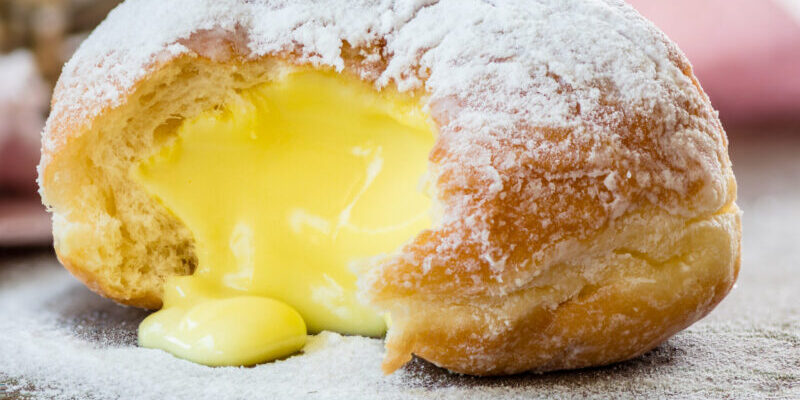
The cream centers that fill different kinds of baked products undergo some of the most demanding processing and storage conditions. This can affect the structure and stability of the filling, resulting in a poor texture and making it difficult for manufacturers to manage fluctuating temperatures and produce a cost-effective recipe.
To help bakers diversify their products portofolio with more techniques, Ingredion has added a range of new cold swelling modified potato starches to its highly functional starch portfolio. Helping to meet the rising demand for sweet baked goods, the SWELY GEL starch range provides manufacturers with a cost-effective, texturizing solution for instant bakery cream fillings and custard creams.
Bakery manufacturers can choose from three different cold swelling modified potato starches, with different grades depending on their processing and functionality requirements. Each potato starch is purposefully designed to provide high firmness, process and freeze-thaw stability, to deliver the perfect thick creamy mouthfeel in every bite.
You can read the rest of this article in the Summer issue of Asia Pacific Baker & Biscuit, which you can access by clicking here.