
ASEMAC Warns of Major Challenges: Absenteeism, Overregulation and Economic Uncertainty
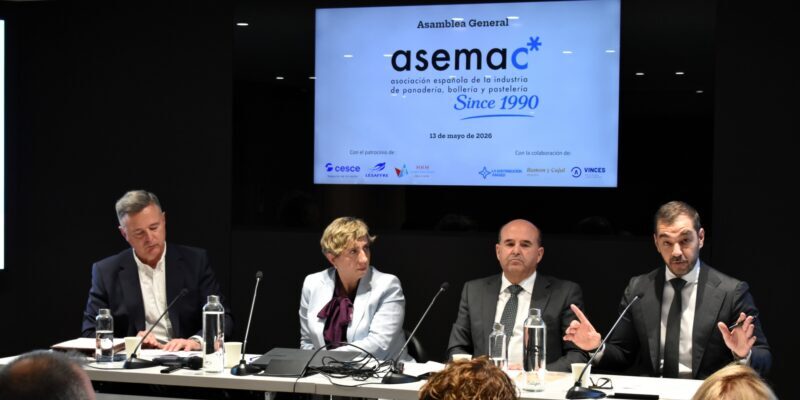
The warning was issued during ASEMAC’s Ordinary General Assembly held in Madrid.
The Spanish Association of the Bakery, Viennoiserie and Pastry Industry (ASEMAC) held its Ordinary General Assembly at the headquarters of Cesce in Madrid, bringing together representatives from leading companies in the sector as well as experts from the legal, economic, institutional and food retail fields.
During the event, the sector examined some of the key challenges currently affecting business activity, including rising workplace absenteeism, increasing regulatory complexity, changing consumer habits and the current climate of political and economic uncertainty both in Spain and internationally.
In her opening remarks, ASEMAC president Isabel Martínez highlighted the resilience of companies in the sector in an environment marked by volatility and uncertainty: “We are used to risk, because risk can be managed. But uncertainty generates anxiety, volatility and makes business decision-making extremely difficult.”
Martínez also stressed the difficulties faced by small and medium-sized bakery and pastry companies in dealing with growing regulatory complexity: “Many small companies are not even capable of understanding all the regulation that constantly reaches them.”
She also publicly recognised the work carried out over several decades by honorary president Felipe Ruano, thanking him for his capacity for dialogue and leadership within the sector.
A structural problem: workplace absenteeism
One of the central topics of the event focused on workplace absenteeism and its impact on business competitiveness. Manuel Martín Moreta, partner at Ramón y Cajal Abogados, described the situation as “a structural problem of enormous economic and social scale”.
According to data presented during the roundtable discussion, close to 1.6 million people in Spain are currently absent from work each day, of which around 1.25 million are related to temporary incapacity due to common illnesses.
Martín Moreta warned that the costs associated with the situation reached EUR33bn in 2025 and underlined the direct consequences for business productivity, internal company organisation and service provision.
Overregulation, a growing concern for companies
Aurelio del Pino, senior advisor at Vinces, focused his presentation on the impact of overregulation and regulatory complexity on businesses. According to Del Pino, companies must not only deal with a growing volume of European, national, regional and local legislation, but also adapt to constant regulatory changes that make business planning more difficult. “The problem is not only that there is too much regulation, but that it is often poorly designed and changes continuously.”
Del Pino said the situation forces companies to strengthen their compliance structures, whether internally or externally, and to constantly anticipate new regulatory requirements, increasing costs and reducing efficiency.
A more demanding consumer shaped by price pressures
María Sánchez, food director at La Distribución Anged, analysed the evolution of Spanish and European consumers, who are increasingly price-sensitive while also demanding healthier, more convenient and higher value-added products.
According to figures shared during the event, more than half of Spanish households struggle to make ends meet and 61% say they are unable to save money. “Consumers do not give up their priorities; they simply filter them through their wallet,” Sánchez said.
She also highlighted the need for companies to continue innovating in order to respond to increasingly changing and demanding consumption habits.
Political climate and institutional uncertainty
The event also featured a presentation by political scientist and Carlos III University professor Pablo Simón, who analysed the Spanish political situation following the electoral cycle that began in 2023 and its impact on institutional and regulatory stability. Simón highlighted the political changes seen across many autonomous communities and major Spanish municipalities, as well as the high level of parliamentary fragmentation currently present in the Spanish Congress.
Institutional closing with AESAN
The closing speech was delivered by Victorio José Teruel Muñoz, deputy director general for Food Safety Management at AESAN, who reaffirmed the commitment of the Spanish Agency for Food Safety and Nutrition to ongoing collaboration with the food sector.
During his intervention, Teruel highlighted the progress achieved together with the industry in areas such as nutritional reformulation and announced new regulatory initiatives aimed at improving information for consumers with food intolerances.
ASEMAC’s Ordinary General Assembly was sponsored by Cesce, Lesaffre and Grupo Harinero La Meta, with the collaboration of La Distribución ANGED, Ramón y Cajal Abogados and Vinces.