
Breaking The Mould
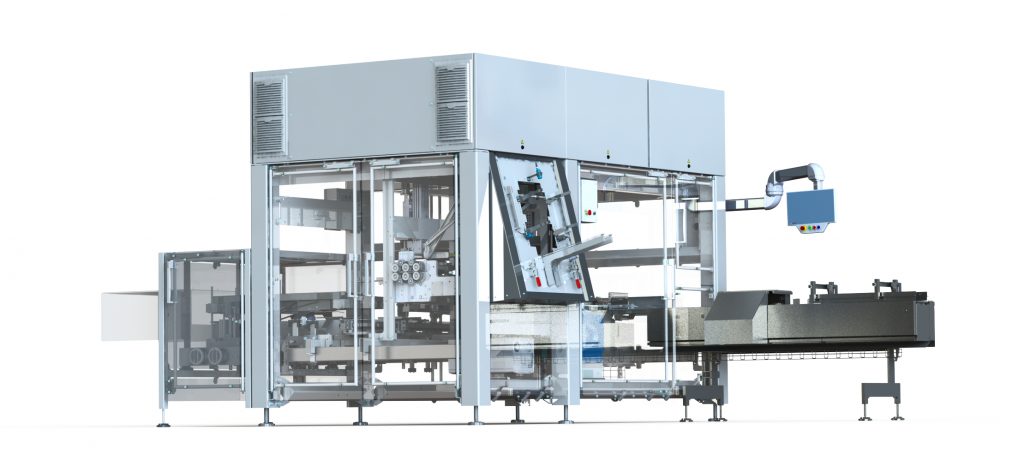
Producing goods that push the boundary just that little bit further is what the industry is all about. With the demand for increasing variety and the creation of more niche markets, bakers and equipment manufacturers need to be flexible. Writer David Abbott takes a look at the world of moulders, rounders and dividers.
A very well-placed contact in the bakery equipment industry (who shall remain anonymous) told me that there are three big players when it comes to moulders, rounders and dividers. The names he mentioned were: Baker Perkins, Benier, and WP-Haton. Of course, he is right; these are the big players – but more of them later.
The interesting thing about bakery equipment is that it’s hard to predict how a company will develop in a fast-moving business environment and, no matter how big the big players are, you can always find other manufacturers keen to get in on the act.
Take Backtechnik S.I. based in Unterkirnach down in the Black Forest where they know a thing or two about baking. Here’s a company that started out by re-servicing ovens and yet is now producing its own tailor made lines and a range of equipment including moulders, rounders and dividers.
The company was started back in 1998 after Winkler had gone bankrupt and the first 10 years have seen it transformed into one of the better known and more innovative – but perhaps smaller – companies working in the industry.
One of the company’s aims has been to develop bread processing lines which use computer technology to control the whole bread line.
“The man who works the line doesn’t have to think about anything,” says Gerd Maag, General Manager.
Maag says that computer technology makes for a line which is easy to use, cheap labour costs and consistent quality of bread. The systems can be programmed with many different recipes, and once in the computer they can be changed by the baker, but computer technology allows every aspect of the process to be repeated time and time again with exactly the same consistency.
More programmes can be added with ease and the labour savings mean that the equipment can be paid for very quickly.
The other great point in favour of computer technology says Maag, is that knowledge stays in the bakery. Staff can come and go, but successful recipes stay in the computer. In a knowledge economy when competitive advantage lies not so much in what you do, but how you do it, that can be a significant advantage.
It’s worth emphasising that Backtechnik’s system controls every stage of the line, not just one. As Maag explains, there can easily be around 20 parameter settings to change each time a different product is made and that leaves a lot of room for those little slips which chip away at consistency. The computer control system means that the chance of these errors occurring can be removed in one go as the computer system automatically adjusts all the parameters.
“In my opinion, all over the world more and more bakers want to work with really soft dough, with high humidity and fermenting in the bowl before it goes to the divider,” says Maag.
Maag says that what makes Backtechnik stand out is that their divider system works with oil hydraulic pressure instead of a spring.
Spring mechanisms tend to give high pressure, making it hard to handle the dough gently and making it more likely that the dough is damaged by an over-vigorous action. A hydraulic system makes the handling very gentle; in fact you can say that it’s as good as a pair of hands, and when it comes to quality, that really counts. The soft touch is also a feature of Backtechnik’s moulder which uses three Teflon-coated rollers to give a very fine and elastic structure to the dough. But there is also a combined bread and baguette moulder in one machine, so all needs are catered for.
Clever technical tricks
Backtechnik also produce a conical rounder which has a few clever technical tricks built in to the design. The conical rounder uses a special oiling system; two pipes – a larger one for air pressure and a smaller one for oil – allow the oil to be applied with the lightest touch. This allows the oil application to be regulated with complete control.
All of the equipment can deal with big capacity and big weights, is built from stainless steel and is proving very popular.
Around 80 per cent of Backtechnik’s machinery is exported, going to the USA, Europe and the Middle East. Three years ago, Backtechnik set up a line in Iran. That’s a pretty impressive record and it’s not difficult to see the attraction. You don’t have to speak to Maag for long to get the impression that this is a man with a highly detailed understanding of precision engineering and a passion for improvement.
Move up north to Pannigen, home of WP Haton and as you might expect, the scale is more industrial. WP Haton doesn’t do things by halves.
Preparing for this article, I have to confess I was puzzled by an email from WP Haton referring to the ‘bread library’. Was this some problem of translation, I wondered?
Talking with Jan van den Berg, WP Haton’s Marketing Manager, all soon became clear. The bread library was literally that; a vast database of all of the different types of bread that WP Haton equipment has been used to make over the last 20 or so years.
“We go this way around; if you want to make this bread, you need this divider, not the other way around”, explained van den Berg. “What we do is put in front of the customer a picture of say, a Turkish bread or a ciabatta and we start discussing from the other side.”
WP Haton produces a wide range of dividers, moulders and rounders, but takes take an integrated approach. You’ve got to look at the whole line and also start with a clear idea of what it is you want to produce. It’s not good enough just to get a piece of equipment because it’s got good technical specifications. The point is – is it right for the specific job for which it is intended?
Trends towards healthier bread means that bakers have to produce a variety of breads, not just the classic lines; that means equipment has to be able to tackle varying demands flexibly, says van den Berg. Hence WP Haton is keen to ensure that its equipment can be used for several different types of bread.
And when it comes to rounders designed for tackling the stickier doughs, Van den Berg explains that there are various means of dealing with this technical challenge.
These can range from using different materials, changing the shape of the cone, using an open track, to spraying oil on the cone or using air. At WP Haton they will employ all of these different methods depending on other variables. There is no single technical solution which is rigidly applied to every problem.
Acids and sugars
One area of development is in the materials used in dividing, moulding and rounding equipment. Some of the breads now being used can contain quite aggressive acids or high levels of sugar, so it has become important to produce machinery which can cope with these ingredients.
WP Haton has put a lot of resources and effort into devising alloys, new coatings and plastics in order to come up with solutions to exactly this sort of problem. It’s in tackling problems like this that WP Haton’s technical know-how is telling.
“You have to use different types of materials for different product lines,” says van den Berg; that’s essential because it would just not be viable in today’s business environment for an equipment manufacturer to service only one type of product.
Van den Berg says that in the last 10 years the company’s business has become increasingly international. People are now buying systems, not just a stand alone piece of hardware. The world has changed and the responsibility for ensuring a system will be up to the job lies with the equipment manufacturer.
Further developments
And in this more complex and riskier business environment what further developments and improvements can we expect to be made in dividing, moulding and rounding equipment?
Van den Berg counsels against expecting some earth-shattering, revolutionary change. There will be no magic bullet. But the desire for increasing variety and the creation of more niche markets means bakers and equipment manufacturers both have to be more flexible. Like the Ford Focus, perhaps dividers, moulders and rounders need a common chassis around which other models can be customised, enabling equipment makers to reach more customers.
WP Haton is a truly global supplier of breadlines, selling equipment in the USA, South Africa, Australia, and the Far East as well as Europe of course; Backtechnik exports the majority of its equipment. That’s a world of opportunity of course, but it’s also a world market which includes very different types of bread.
It’s also a market where very different sized businesses can prosper by listening carefully to what producers want. In their different ways, both WP Haton and Backtechnik are doing their bit to break the mould, producing equipment which pushes the boundary of what is possible just that bit further.