Keeping Food Safe and Plenty during Coronavirus Pandemic
Institutes and organizations worldwide announced scientific and market data they are collecting, as companies readjust to maintain product availability, including baking businesses.
The U.S. Department of Agriculture has announced that its agencies including the Food Safety and Inspection Service, Animal and Plant Health Inspection Service, are committed to ensuring the health and safety of their employees while still providing the timely delivery of the services to maintain the movement of America’s food supply from farm to fork. “We have all seen how consumers have reacted to the evolving coronavirus situation and how important access to food is to a sense of safety and wellbeing. It is more important than ever that we assure the American public that government and industry will take all steps necessary to ensure continued access to safe and wholesome USDA-inspected products,” said Dr. Mindy Brashears, USDA deputy under secretary for food safety, Greg Ibach.
In the European Union, EFSA is closely monitoring the situation regarding the outbreak of coronavirus disease (COVID-19) that is affecting a large number of countries across the globe. There is currently no evidence that food is a likely source or route of transmission of the virus, the organization reassured. EFSA’s chief scientist, Marta Hugas, said: “Experiences from previous outbreaks of related coronaviruses, such as severe acute respiratory syndrome coronavirus (SARS-CoV) and Middle East respiratory syndrome coronavirus (MERS-CoV), show that transmission through food consumption did not occur. At the moment, there is no evidence to suggest that coronavirus is any different in this respect.”
On the other hand, American Bakers Associations, the Washington D.C.-based voice of the wholesale baking industry in the U.S., stressed the critical importance ofsharing accurate information with the American people. They stated that America’s food supply remains plentiful and safe and the United States is at no risk of running out of essential food and beverages. “Even with the declaration of a National Emergency and similar declarations by various states, food production and distribution are part of the nation’s critical infrastructure, which puts guaranteed safeguards in place so our industry can continue feeding our country’s citizens,” the association underlined.
Furthermore, ABA announced a webinar: Food safety and COVID-19 – What you need to know, on March 23, 2 pm EST. Dr. David Acheson will discuss the following key areas for the baking sector as it responds to the rapidly changing COVID-19 situation: a general update of the global status, clinical presentation, spread of the virus, the policies and procedures you should have, how to manage positive and potentially positive employees, managing as part of the critical infrastructure and what to expect going forward.
Campden BRI published a video summarizing the main points around the new coronavirus in relation to food and drink, inviting Martin D’Agostino, virologist, to talk about the new pandemic and how it is influencing the food industry.
La Federation des Entreprises de Boulangerie (FEB) / France Bakery Federation, which brings together 280 companies from the bakery-pastry sector, has called on the public authorities, as it has been lobbying for bakeries to have the right to be open seven days a week.
As a result of the measures taken by the government on March 16, the bakers want to meet the expectations and first-aid needs of the French population. Consumers are looking for products that can be bought and consumed daily. The proximity of the bakeries to their home is also an important point to minimize travel, the federation underlines. The sector welcomes the government’s decision to allow bakeries to open 7/7 to meet consumer needs. Matthieu Labbé, delegate general, said: “It is a strong decision by the government to streamline consumer expectations. Our companies are aware of being at the forefront of this unprecedented health crisis, they will be able to mobilize and live up to it. ”
Companies Take Measures
AMF Bakery Systems has announced that, in order to respond to the Center for Disease Control (CDC) and World Health Organization (WHO) guidance, AMF has restricted non-essential business travel and non-essential visits to its plant locations. Their site engineers remain available for remote support and their regional technicians are available for essential bakery installation, service, and repair work within the CDC and WHO travel recommendations. As a precaution, AMF asked all customers to check their stock levels of AMF spare parts (particularly critical and wear items) and to re-stock accordingly. This will help AMF to manage any sudden increase in demand. In terms of new machine production, the facilities in North America, Europe, and China remain at normal capacity and committed to fulfilling existing orders as well as supporting new business moving forward.
Associated British Foods is closely monitoring the current and potential effects of the outbreak on their operations. The situation regarding the suppliers in China has improved from February, with most factories supplying Primark having re-opened. As a result, supply shortages from China are now expected to be minimal, the company said. “Importantly, in aggregate we have not seen a material impact on our sugar, grocery, ingredients, and agriculture businesses. Given the effect of COVID-19 on Primark’s sales, it is too early to provide earnings guidance for the remainder of the current financial year,” ABF added.
Lesaffre announced that all their production sites are operational, and their teams are continuing their efforts to meet your customer requests in the coming days and weeks. “Be assured that we will stay in touch with you. Let’s stay connected to discuss your concerns, find the answers to your questions together and let us know if you have any additional needs. We will continue to adapt to the evolution of COVID-19 by focusing first and foremost on your ongoing safety and service,” the company said.
The Barilla Group is by Italy’s side as it continues to face the current emergency. The company has made a total donation of over EUR2m to the Maggiore Hospital of Parma, the Civil Protection and the Red Cross of Parma. “The Italy that stands strong is represented by all of us: they are the people who work in the food supply chain, they are all of the workers who, with a sense of responsibility, allow us to continue bringing our products to the homes of Italians. Above all, they are the doctors, nurses and operational staff to whom we are immensely grateful for the extraordinary work they are doing to deal with the emergency,” said Luca Barilla, vice chairman of the Barilla Group.
Fazer took extensive measures: the company mentioned it is monitoring the situation constantly and is prepared to make any necessary adjustments to their operations and to inform the customers and employees accordingly. Fazer Group has appointed a task force to manage the preparations for the coronavirus and to issue daily instructions and has prepared in business operations. “We will inform our customers of any impacts of the coronavirus on our business. All Fazer business units have business-specific contingency plans for the coronavirus epidemic,” they stressed. Fazer production units are working normally.
The company is focusing on preventive measures. Business trips are canceled and encouraged the employees to work from home. All visits to the production facilities are forbidden.
Bühler decided to host a virtual tour, as interpack has been postponed to mitigate the risk of spreading the coronavirus. The event will be held May 11-15, 2020, a virtual interpack under the motto “Creating food sensations” with digital showrooms, chats, and webinars to present its latest technologies and solutions. “The interpack 2020, like many tradeshows around the world, has been canceled to keep people safe and mitigate the spread of the coronavirus. This cautionary decision is a positive step for the health and safety of our customers and employees,” said Germar Wacker, CEO of Bühler’s consumer foods business.
“The current challenges require us to explore new ways of reaching out and preparing for the future. In this case by running events digitally and discovering the potential of virtual events. We ask all our customers and interested people to keep the interpack dates in their calendars,” he added. Within the next days, Bühler will invite everyone who had planned to travel to Düsseldorf to join the company’s virtual booth online, get inspired by new end-product compositions, meet Bühler experts and salespeople in chat rooms, or enter technical presentations online. “There are so many challenges and opportunities in the consumer foods market today that deserve new solutions. We want to invite all our customers to explore these solutions in a completely new, virtual format which also allows for individual discussion,” said Germar Wacker.
German company Koenig stated that its production is still running, to keep the business going for its customers, suppliers, and employees. “We make sure to keep your production on our lines running. Our worldwide 24/7 service hotline is available for you as well as our service team and spare parts delivery. However, due to increased border controls and transportation limitations beyond our control, delivery delays may occur for which we kindly ask you for your understanding,” Koenig said. The company has also taken measures to ensure their employees’ health while still maintaining production.
Aasted announced its own measures to ensure the health of its employees, meaning the team works remotely if their job allows. The company is also safeguarding its production by introducing dual shifts. Its supply chain has not been interrupted, although some bottlenecks are occurring in shipping. Aasted is leveraging its global network and working proactively to re-route orders, expedite alternative component supply, and bring up additional manufacturing capability in other regions, according to a recent annoucement.
Packaging specialist Volm announced that its ability to provide packaging, equipment, and services during the COVID-19 outbreak will remain strong. “We anticipate very little disruption in our ability to supply products and service equipment. Volm has spent years building a decentralized business model across all key business units, which allows us a level of protection against calamitous situations in localized areas. We utilize domestic manufacturing for all the Volm main product groups utilizing multiple plants in different regions across North America; this ensures that if a virus outbreak occurs at any single location, we have manufacturing redundancy at other Volm manufacturing locations,” the company stated. On the other hand, the company suspended all non-essential intercompany and international meetings, training, conferences, and trade shows and travel through the end of March.
Impact on Businesses
Small businesses worldwide are seriously impacted by the authorities’ decisions to send people to quarantine, self-isolation or recommendations to avoid social contact, including restaurants and coffee shops. While eating out is limited, delivery/drive-through services are available.
Coffee chain Starbucks decided to close its seating areas across the United States. “We have temporarily closed our seating area, but we remain open to serve you. Please accept our apologies for any inconvenience,” the chain stressed. Customers can still order drinks and snacks using the Starbucks app and by delivery or drive-through. Many shops are open for customers to grab and go, but for at least two weeks, they won’t be able to sit and sip.
Steve Magnall at Two Magpies Bakery, UK, expressed his concerns about avoiding contact in restaurants and bakeries. “This has massively impacted sales today and we are now planning for the worst. So contingency planning is around potentially closing our cafés and only doing take-out, while also reducing our range and increasing bread production which will be a staple for everyone in the coming weeks. Our concerns are for our staff in this uncertain time. We will run out of cash if customers do not come into the cafes and this will impact on employment. The government has to intervene and support the staff and business so we can pay peoples’ wages, suspend rent and mortgage payments and protect the future of all these people and businesses,” Magnall said.
Another example of business affected is American Pane d’Amore Artisan Bakery which announced it was closing its three stores amid concerns over the spread of 2019 novel coronavirus (COVID-19) in Washington state. Pane d’Amore has bakeries on Bainbridge Island, Sequim and Port Townsend. “Our self-quarantine measures make it impossible for us to meet production safely. The financial impact of this decision on our employees and the business cannot be overstated but we all must put health and safety first,” the owner Linda Yakush announced.
Businesses Making Profit
However, not all the businesses around the world are affected, as people are still looking for bread. In France, 67 million people consume nine billion of the long loaves every year. Bakers are among the few essential-service businesses allowed to stay open in France under strict anti-virus confinement measures that took effect on Tuesday. And they are thriving, with long lines in the cities and countryside alike.
“Our numbers have doubled since Monday. We are now at 800 baguettes per day. Yesterday, for example, we had no baguettes left to sell by 3 pm,” Addenour Koriche, sales manager of a bakery attached to a large supermarket north of Paris, told AFP.
Consumer Behavior
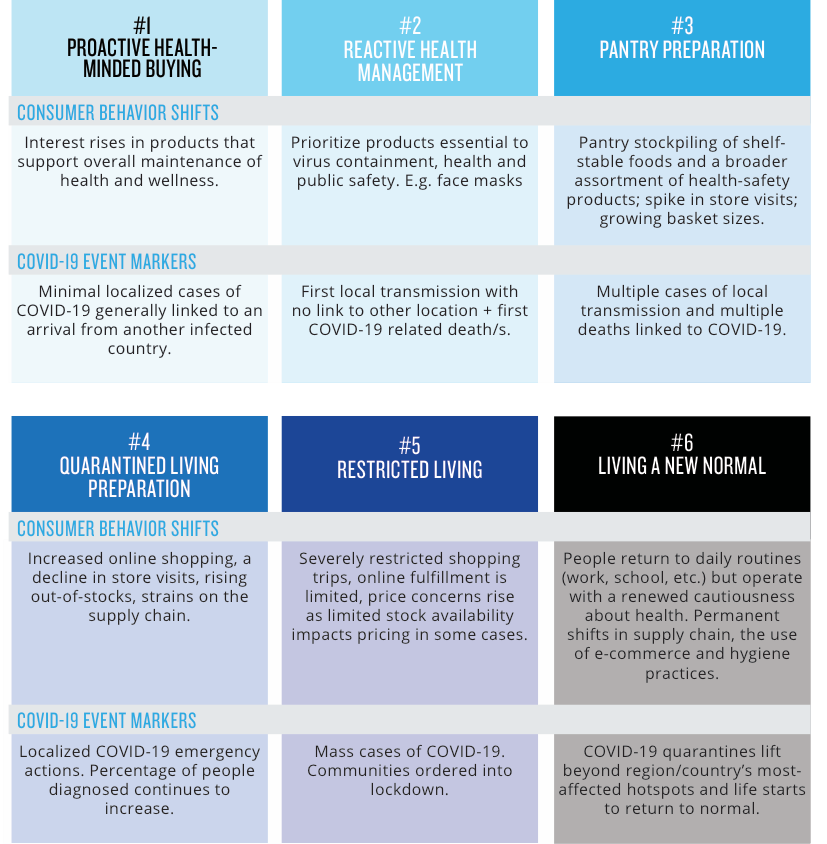
A Nielsen investigation has identified six key consumer behavior threshold levels that tie directly to concerns around the novel coronavirus (COVID-19) outbreak. The thresholds offer early signals of spending patterns, particularly for emergency pantry items and health supplies, and we are seeing these patterns being mirrored across multiple markets.
Correlating COVID-19 news events, such as public health announcements and government press conferences with consumer spending on items such as hand sanitizers and shelf-stable foods, reveals a series of recurring patterns. These patterns (though still evolving), when reviewed across impacted countries, help provide a set of leading indicators for packaged goods manufacturers and retailers faced with supply issues as they race to meet record levels of demand and changing purchase habits.
The six threshold levels, based on early indicators across markets (though at different times as the virus outbreak evolves at different rates in different geographies), are detailed below. Each one correlates with different levels of consumption, but there are some common timing elements, which are primarily driven by news cycles.