
Extruders: A Recipe for Baking Success Through Innovation and Flexibility
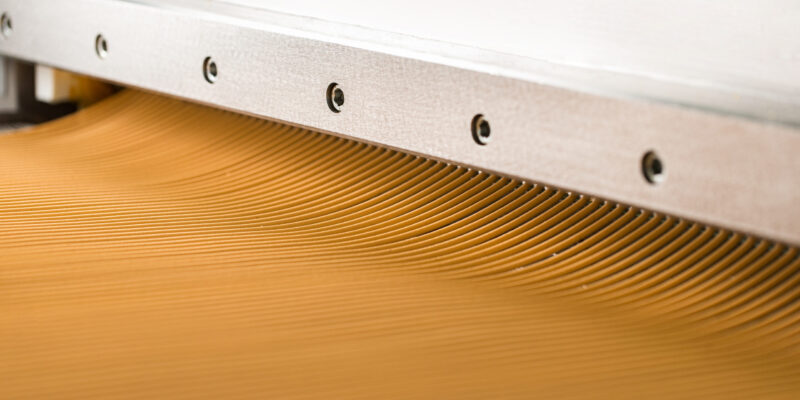
Extrusion technology is one of the most established and widely used techniques used within the global food processing industry. It encompasses the compression of food products through tiny openings in a holed die or plate using single or a sequence of screws, after which they are cut to a pre-determined size via the use of blades. They are then baked at high temperatures, prior to being enclosed within a container.
Extrusion technology continues to develop in response to changing market demands and conditions. Manufacturers of extruded snacks mostly use either single-screw or twin-screw technology. Single-screw extruders tend to be lower in cost and therefore more affordable, mostly because they feature a simpler design and do not offer the same type of capabilities as twin-screw extruders – for example, they do not provide the same quality in terms of mixing and heat transfer. However, they are easier and less costly to maintain for operators.
Twin-screw extruders are becoming more widespread within the food processing industry, as companies seek to diversify their product range and enhance quality levels for their foods. Although they represent a higher capital investment, twin-screw extruders are a better proposition for the manufacture of snack foods in a range of different shapes, sizes and designs. The co-rotating screws provide a better heat transfer during the process, as well as allowing operators to add various ingredients to the mixture to improve or enhance their quality levels in terms of taste and/or nutritional profile – typical examples have included fruits, vegetables, protein, fiber, vitamins and ancient grains.
Other advantages offered by twin-screw extruders include the following:
- Greater productivity – as twin-screw extruders are more adaptable than their single-screw equivalents, they can handle a wider range of raw materials and recipes. Furthermore, they do not experience a fall in performance when the screws wear out.
- Improved mixing – the components of twin-screw extruders allow a more precise modification of the amount of shearing or mixing, enabling greater control over the quality and strength of the mixing process.
- Greater flexibility – this is due to their ability to handle a range of processing operations simultaneously, such as cooking, mixing, chilling, heating and melting. In contrast, single-screw extruders are hampered by their reliance on capacity and spin rate.
- More precise control of temperature.
- Efficient heat transfer via the connective screws.
According to latest data from Precedence Research, the global market for food extrusion technology was worth over USD76bn in 2021. Between 2022 and 2030, annual growth in market value is forecast to average around 4%, reaching USD110.7bn. Europe has the largest regional market, accounting for 45% of global sales in 2021. Savory snack applications account for the largest sector of the global food extrusion technology market, ahead of breakfast cereals.
Flexibility Is Key
To be successful, equipment flexibility is the key to keeping capital investment costs down and production uptime up. Reading Bakery‘s Low Pressure (LP) Extruder is a flexible alternative to conventional dough forming and sheeting systems that offers new, cost-effective opportunities to the snack food industry. Featuring state-of-the-art advances in efficiency, sanitation and safety, it is able to create a variety of structural and flat extruded snacks without producing scrap dough that must be recycled. From hard pretzel shapes and sticks to bread snacks, twisted sticks, filled products, fried rings and more, the LP Extruder enables production of a wide array of products with just a simple change of the compression head and forming dies.
You can read the rest of this article in the September-October issue of European Baker & Biscuit, which you can access by clicking here.