
SAVE FOOD Congress 2017: Fighting Food Losses and Waste
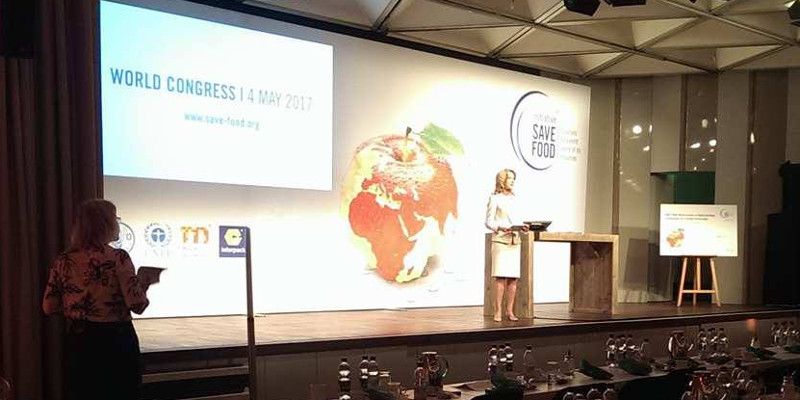
The third edition of the SAVE FOOD Congress was held on May 4 as part of interpack 2017, proposing a multi-dimensional approach for fighting food losses and waste. Speakers from the political stage, the food and packaging industries, retail, research and civil society brought perspectives on national conditions. The Congress also identified and discussed best practices.
UPDATE: SAVE FOOD Packaging Awards
In 2017, the award presented annually was extended to include another category, “SAVE FOOD Packaging Award”, which is designed to recognize packaging solutions that can help to reduce food loss and waste. Those eligible are sustainable concepts with the lowest use of resources possible.
The SAVE FOOD Packaging Awards recognizes packaging solutions distinguished by their capacity to reduce food loss and wastage – for instance, by prolonging the packaged product’s shelf life or with intelligent concepts for portioning or protecting the contents of packages once they have been opened. It is also important that the package’s production is resource-efficient and makes use of as little packaging material as necessary.
Vytenis Andriukaitis, EU Commissioner for Health and Food Safety, mentioned that the situation, estimated at 88 million tons of food wasted every year in Europe, is unaffordable, immoral and unsustainable. “20% of produced food is wasted or lost with an economic cost amounting to EUR 143 billion. These numbers indicate not only the financial loss, but also the environmental price we pay. Wasted food is wasted land, water, natural and human resources that were used to produce food which is ultimately never consumed,” Andriukaitis said.
Topic of SAVE FOOD Congress
The speakers at SAVE FOOD Congress approached topics as:
– “Nutrition in the 21st Century” (Kostas G. Stamoulis, Assistant Director-General of the Economic and Social Development Department, FAO – Food and Agriculture Organization of the United Nations);
– “Evaluating foodstuffs – “Too Good for the Bin” – a successful German campaign” (Dr. Klaus Heider, Department Manager “Nutrition policy, Product safety, Innovation” in the Federal Ministry of Food and Agriculture);
– “Rescuing food as part of the Circular Economy: towards a sustainable EU food policy” (Vytenis Andriukaitis, EU Commissioner for Health and Food Safety);
– “Opportunities in the Food Processing Sector in India (Gargi Kaul, Joint Secretary and Financial Advisor, Ministry of Food Processing Industries, India);
– “The role of innovative packaging concepts in avoiding food waste along the supply chain and in the consumer domain” (Christian Traumann, Managing Director and CFO at MULTIVAC);
– “Beyond the Horizons: SAVE FOOD and Climate impacts” (Dr. Prajal Pradhan, Research, Potsdam Institute for Climate Impact Research).
Friedbert Klefenz, president interpack 2017, said in his opening remarks: “The packaging industry and related process industries can make a decisive contribution to solving the global food loss and waste problem. By using state-of-the-art technology and materials or smart packaging, food waste can be counteracted that can be predominantly observed in industrialized nations.
Basic technical applications, in turn, can reduce losses in developing countries, which already occur at the stages of harvesting, storage and transport. At interpack, the latest developments are presented in all fields of application charting the course for future progress. Companies also have their sights on sustainability, as the lowest consumption of resources possible (in terms of production and materials) is decisive here for obtaining the optimum ratio between consumed and conserved resources.
Food Waste in Numbers
Food waste numbers in the EU speak for themselves: it is estimated, that in Europe only we discard around 88 million tons of food every year. Up to 20% of the food produced is wasted or lost, meaning EUR 143bn.
“These numbers indicate not only the financial loss, but also the environmental price we pay. Wasted food is wasted land, water, natural and human resources that were used to produce food which is ultimately never consumed. Not to mention animals slaughtered in vain and climate-changing greenhouse gas emissions irretrievably emitted,” said EU Commissioner for health and food safety Vytenis Andriukaitis, in his remarks.
As many as 800 million people every day go to bed hungry while safe and nutritious food is being thrown away all around the world. “Such situation is unaffordable, immoral and unsustainable,” he added.
Improvements can be made throughout the food production chain. “At the EU level, we have started the battle against food waste and food loss. We are about to rethink how we produce, market and consume food at each step in the food supply chain in order to achieve the Sustainable Development Goal targets for food waste reduction in the EU – in particular, to cut by 50% both retail and consumer food waste by 2030,” explained the official.
For the entire duration of interpack, visitors will be able to observe concrete solutions and approaches revolving around SAVE FOOD, at the innovation parc. About 20 companies are exhibiting at the white tent located in between the four bakery and confectionery halls.
The SAVE FOOD Initiative:
In close collaboration with FAO and UNEP, Messe Düsseldorf Group intends to make a contribution to the fight against global food loss and waste. It launched the SAVE FOOD Initiative with the aim of encouraging a dialogue on food loss and waste between industry, research, politics and civil society. For this purpose, the initiative will regularly bring together stakeholders involved in the food supply chain from the food industry, retail, packaging, and logistics for conferences and projects and will support them in developing effective measures. Raising awareness among consumers is another major goal.