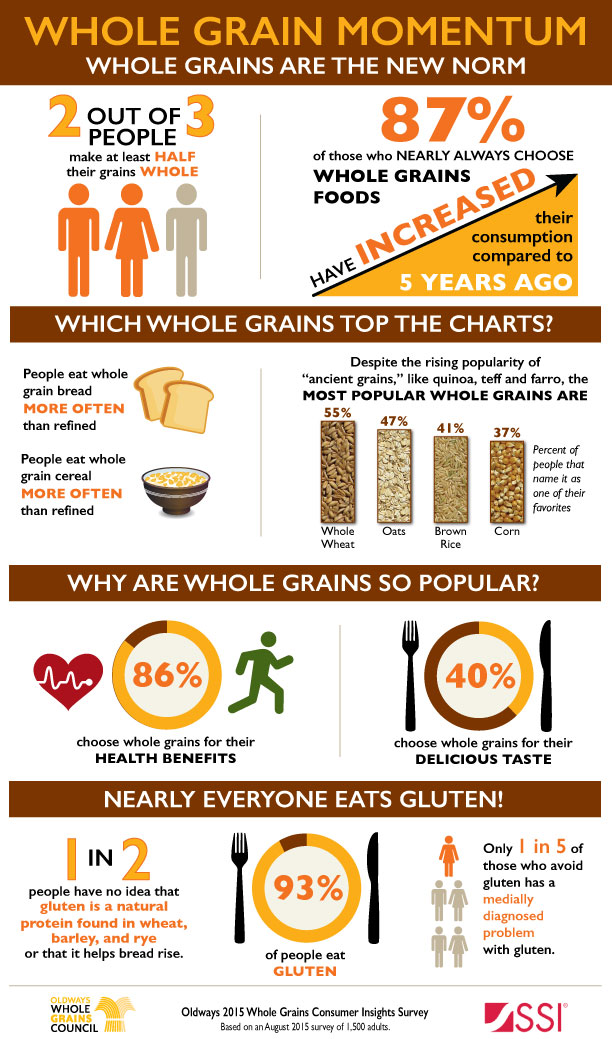
Two-thirds of Americans Prefer Whole Grains

Nearly two-thirds of Americans choose whole grains and another third of them prefer this type of grains about half of the time.
The consumption of whole grains increased, since 2005, when the Dietary Guidelines for Americans had encouraged to “make at least half our grains whole”, according to new data from the WGC’s 2015 Whole Grains Consumer Insights Survey.
1,510 U.S. adults answered from July 27 to August 3, 2015 to SSI (Survey Sampling International) and their answers are very interesting.
Whole grain consumption is up
Nearly two-thirds (64 per cent) have increased whole grain consumption “some” or “a lot” in the last five years.
Almost one-third of respondents (31 per cent) say they nearly always choose whole grains. Five years ago, only 4 per cent would have said this.
Another third (32 per cent) choose whole grains about half the time. Combined with the “nearly always” group, this makes 63 per cent making half or more of their grains whole, in line with the Dietary Guidelines for Americans.
We eat about 37 per cent of our whole grains at breakfast, 27 per cent at dinner, 22 per cent at lunch, and just 14 per cent as snacks. One possible reason? It’s often harder to find whole grains outside of the home, where most lunches and snacks are generally eaten.
Why they are choosing whole grains
Nearly 9 out of 10 (86 per cent) of those who consume whole grains do so for the health benefits. Four in 10 (40 per cent) choose whole grains because they enjoy the taste.
Why they don’t always chose whole grains
Cost was named as the leading barrier to eating more whole grains (39 per cent).
Some of them aren’t yet accustomed to the fuller, nuttier taste of whole grains (37 per cent). Those who prefer the taste of whole grains (40 per cent) are beginning to pull ahead!
Availability can also be a barrier (28 per cent), especially since many restaurants don’t offer whole grain choices.
Gluten confusion continues
While more than 1 in 3 correctly identify gluten as a protein found in wheat, barley and rye, and 1 in 5 know it makes dough rise, only 4 per cent correctly selected both (and no other options). Although 96 per cent didn’t know the complete answer, only 25 per cent picked “Don’t know.”
Few other wrong answers were: “It’s a dangerous carbohydrate” (8 per cent); “It’s an unnatural substance found in genetically modified (GMO) grains”; (11 per cent) and “It’s a substance that makes you gain weight” (11 per cent).
21 per cent incorrectly think gluten is in all grains. In fact, gluten free doesn’t mean grain free – even those following a gluten-free diet can enjoy grains such as amaranth, buckwheat, corn, millet, oats, quinoa, rice, sorghum, teff, and wild rice.
93 per cent eat gluten some or all of the time. Of the 7 per cent who completely avoid gluten, only 1 in 5 has a medically-diagnosed problem with gluten. Only 1.5 per cent have a medical reason to avoid gluten completely.
We know what we like and we like what we know
Old favorites — whole wheat, oats, and brown rice – are most popular with Americans. 9 out of 10 have heard of these three whole grains, and most have eaten them.
Fewer than 1 in 5 has heard of spelt, farro, amaranth, Kamut or teff.
When asked to name their one favorite whole grain food, the top choice was whole wheat bread (31 per cent), followed by oatmeal (27 per cent) and then a tie between popcorn and whole grain cold cereal (15 per cent each). Whole grain pasta was the favorite of 8 per cent.
In fact, whole grain bread and whole grain cereal (hot and cold) are the two foods most likely to be eaten in whole grain form by Americans.
The whole grain stamp is known and trusted
49 per cent of people are aware of the Whole Grain Stamp.
Eight out of ten (82 per cent) trust the Whole Grain Stamp to accurately state a products’ whole grain content.
79 per cent say the Whole Grain Stamp would make them more likely to buy a product; about half of these would also consider sugar, sodium, and other product factors.
About half (51 per cent) say they would question a product’s claims about whole grains if they did not see the Whole Grain Stamp.