
Craft Baking and Proofing
The history of baking goes back centuries and artisanal baking is still popular among “purists” and bread lovers the world over. But what does it take to be artisanal? There are many definitions and Andre Erasmus has a brief dabble into the baking and proofing stages.
The Oxford English Dictionary defines an artisan as “a skilled worker who makes things by hand”. So, if we accept this definition as correct, it could almost mean any baker with a good measure of skill and experience is an artisan or a craftsman. But, is he or she only an artisanal baker if they are making their product by hand?
There is no guarantee these days that the local “artisan bakery” makes all its loaves by hand, given the increasing demand from an ever-growing population.
But we readily accept sourdough bread, for instance, as “artisan bread”. And it is more the method in modern times – as opposed to “industrial” baking – that defines the product.
As demand for good baked goods continues to escalate, even trends like “bake-off” are emerging as acceptable in the “artisan” world. Basically, an artisanal loaf is bread made by a craftsperson using largely traditional techniques. It is usually assumed that such a bread is generally made by hand, however many artisanal bakeries use mixers, hydraulic dividers, and molders so the amount of hands on craftsmanship is greatly diminished. There is a lot of argument in artisan bakeries about where the line should be drawn between artisanal bread and artisanal-style bread.
The artisanal approach
Nicholas Fereday, executive director and senior analyst with Food & Agribusiness Research and Advisory for Rabobank in New York, sees a bright future for the US baking industry with the artisanal sector set for growth. In his investment and commercial overview of the baking industry in a September report, he said that even though the industry is “struggling with many of today’s trends”, it has a bright future.
Fereday views the market for artisanal style products as especially promising for baking, partly because the segment has enjoyed success in the recent past. “Artisanal/unpackaged cakes and pastries grew by 4.8 per cent per annum between 2010 and 2013, compared to 2.7 per cent for industrial cakes and pastries,” he said. “Similarly, packaged bead sales grew at 0.7 per cent per annum compared to 1.8 per cent for unpackaged/artisanal bread over the same period.”
And well-known English food lover and chef Jamie Oliver also gives his support for artisanal bread. He says, in his Flour Station web page: “Not all bread is created equal. You don’t need to be a baker, a foodie or even fully awake to notice that tearing into a crusty, freshly baked loaf is a lot nicer than the supermarket sliced variety”. Oliver adds that the Flour Station uses the term “artisan” or “craft” to signify the use of traditional baking methods for “every handmade loaf”.
Tools in action
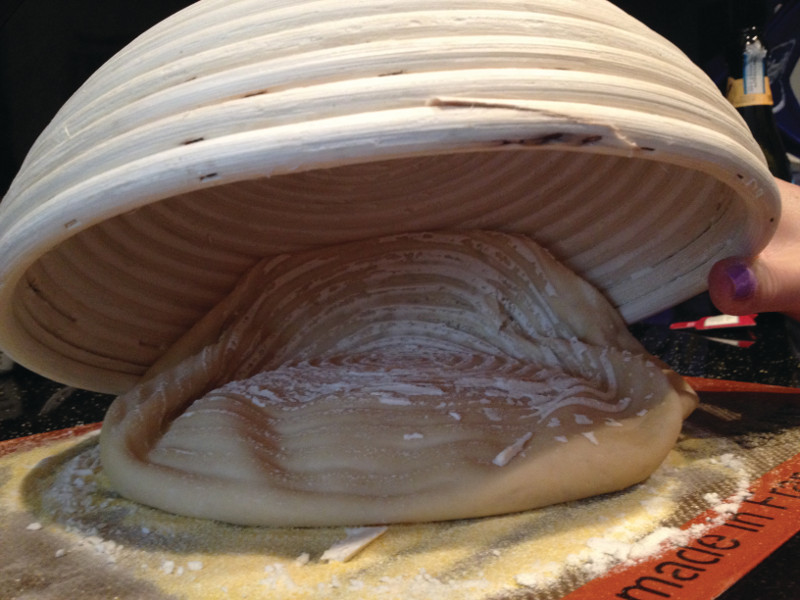
Banneton baskets, also called Brotform baskets, provide the loaf with shape, structure, while wicking away moisture from the crust. A banneton is used for round loaves, called boules. A proofing cloth, or couche, made of linen or other coarse material is typically used for longer loaves such as baguettes.
The proofing stage is when the baker divides and shapes the dough using flour to keep it from sticking too much, or oil, depending on the proofing method and desired crust. The baker can shape the dough into loaves, boule, baguettes or rolls at this step and place the smooth shaped dough in the proofing basket, baking basket, or loaf pan to rise.
To form a nice crust (as opposed to soft crust), the baker will want a wooden or wicker proofing basket or banneton or proofing cloth.
Though proofing in a loaf pan can be much simpler, since most pans made of metal or glass, they are not able to wick away moisture from the crust. As a basic rule, the baker proofs long enough to let the dough double in size. Generally speaking, over proofing will ruin the structure of the bread, leading to collapsed loaves or holes that are too large, while under proofing will lead to a denser, less flavorful bread.
Bread meets oven
Next comes the all important baking stage and artisanal ovens vary.
Four Grand-Mère, located in the Vosges Mountains of France, produces a wide range of wood fired ovens for individual homeowners, professionals, bakeries, restaurants and Industry.
The company Four Grand-Mère is made up of a team of 30 craftsmen and its design department can create a custom-made oven to meet a baker’s specifications.
The company has been developing innovative techniques since 1979 with its biggest ovens completely assembled in the factory then disassembled, packed and shipped to bakeries as far away as Australia and Canada.
The dome-like and wood-fired ovens feature the refractory, where the food is cooked, which is surrounded by highly-efficient insulating material to increase the substantial heat retention capabilities of the oven.
Baking ovens to meet requirements
Four Grand-Mère ovens work on the principle of high-thermal mass to create an even radiant heat. The even warmth creates delicious golden breads, pizzas and cakes.
German manufacturer Miwe also boasts an efficient wood-fired oven, the AHO.
The origins of German oven construction, says Miwe, are the brick-built and directly heated ovens. The combustion chamber is simultaneously the baking chamber.
The Miwe AHO is constructed in line with these century-old traditions. Vaults, deck rings and deck plates are made from high-quality chamotte stones. They have the excellent feature of absorbing heat fast, saving it and releasing it slowly to the baked products during the baking process.
The AHO can operate in the traditional bakery or in a smaller more commercial bakery where the baking is done in front of customers.
Due to its unique atmosphere and rustic ambience as well as the growth in artisanal baking popularity, the Miwe AHO is undergoing a renaissance and is available throughout central Europe, said a company spokesman.
US-based Empire Bakery Equipment offers a rather novel artisan oven for limited floor space. This is the MiniTube, a stone-hearth, artisan quality oven, which has been designed for the most discriminating baker, producing exceptional quality artisan breads. The secret is in the advanced vapor tube technology that facilitates heat distribution and retention.
Vapor tubes deliver heat evenly throughout the product zone, with no moving parts necessary to distribute the heat. This provides consistent quality from front to back, side to side and deck to deck. In addition each deck has its own self-contained steam generator, so there is no need for a steam boiler. Bakeries will save on fuel, space and maintenance.
At the other end of the scale, Empire offers the Ultimate-LF Oven which retains a tremendous amount of heat as the burner chamber and firebox are made of oven brick, and the vapor tubes that distribute the heat are encased in poured cement walls and roof. When the burner shuts down, the oven continues to provide even, radiant heat to your bread — just like a brick oven.