
Exclusive: Advice for Complete Processing Automation in a Biscuit Plant
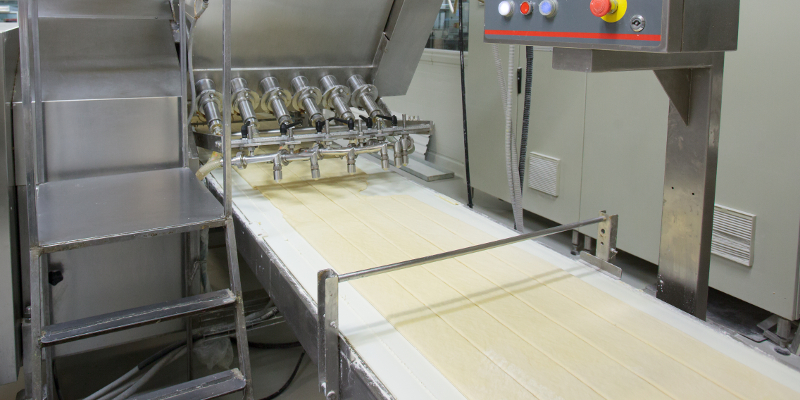
Biscuit World magazine had the occasion to speak with a specialist from Haas-Meincke A/S about how to establish a state-of-the-art plant, in terms of complete processing automation of sheeting and cutting. The interesting information we obtained was divided into two parts and was used for two articles: one in issue 2 (Summer) of the Biscuit World print magazine and the second part published at WorldBakers.com.
The production of biscuits is a sequential process. The specialist from Haas-Meincke A/S we spoke to explained that each stage of the process has to be perfect in order to produce a quality product in an efficient manner.
A must-have in a modern and efficient biscuit plant:
- Digital technology means that each sheet can be cut to exactly the same size with meticulous accuracy;
- A cut sheet means no folding and perfect product weights across the board;
- High-speed layering means that dough is well-supported and layered down without any folds;
- Fat and flour can be included between the laminations without disrupting the process;
- State-of-the-art software allows the operator to change the number of laminations by changing a single parameter;
- Gauge roll gap adjustment in real time and continuous active feedback to maintain the actual gap at the required set point;
- Advanced control and automation allows for real recipe control that reduces changeover time and allows for flawless execution of product startups, saving time and reducing product waste;
- Ability to independently change the speed of the top and bottom rollers for quickly adapting to different dough types;
- A mobile laminator that is able to move between two different production lines, depending on production scheduling.
For those interested in an optimum operational setup for an artisan bakery of average production capacity, the specialist stated that since a 30m X 1.2m oven is generally the smallest size that will allow for a ROI (return on investment) within a reasonable time, it is unlikely that this type of biscuit production equipment will be of interest to an artisan bakery. However, for larger concerns and start-up companies, it is possible to begin with a sheeting line, for example; then, as the business grows, more technologies such as laminating, rotary molding depositing and wire cutting can be added, as well as lengthening the oven for increased capacity.
The amount of lamination used in a specific product will depend on the textural properties required in the final product. Typically, there is a bell curve for each product, where increasing the number of laminations will make a product lighter and more open in texture until the optimum number of laminations is reached; if one continues to increase the number of laminations after reaching this point, the texture of the product will become harder and denser. Producing a range of product samples with different laminations will help to establish the optimum number of laminations for your product.