
Managing Multi-Phase Dosing In Industrial Bakery Production
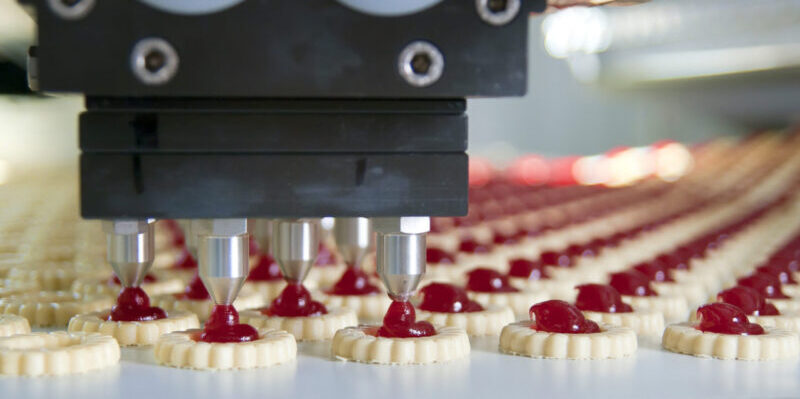
Production losses in filled bakery products are rarely caused by inaccurate portioning. They originate earlier—inside the hopper, during transfer, and in the way fillings behave under pressure, residence time, and temperature variation.
A fruit preparation that separates during a long run, a cream that loses aeration under pumping stress, or a particulate system that settles unevenly will not be corrected by downstream dosing precision. The depositor will replicate that instability across every lane.
This is where dosing becomes a constraint. Not because the system cannot meter accurately, but because the material entering the system no longer behaves in a stable, repeatable way.
Multi-Phase Fillings Introduce Mechanical And Process Conflict
Industrial bakery fillings are increasingly multi-phase systems, combining fat and water components, air incorporation, and solid inclusions. Each responds differently to mechanical stress.
Aerated fillings introduce compressibility. Under pressure, air structures collapse, altering density between deposits. Even with precise volumetric control, weight consistency becomes unstable at higher speeds.
Particulate systems introduce transport limitations. Fruit pieces, nuts, or fibrous inclusions must pass through pumps, valves, and nozzles without degradation or blockage. Smaller outlet geometries improve control but increase clogging risk and shear stress. Larger openings preserve inclusion integrity but reduce deposit definition.
Temperature-sensitive fillings add another layer of variability. Fat-based systems in particular shift viscosity with relatively small temperature changes, especially over extended production runs. A filling that flows predictably at startup may behave differently hours later.
In multi-component products, synchronization becomes critical. The relationship between outer dough and inner filling must remain stable during forming and cutting. Any imbalance leads to leakage, deformation, or structural failure.
These constraints are cumulative. Under production conditions, the behavior of the filling—not the nominal performance of the machine—determines dosing stability.
Where Dosing Systems Break Down In Practice
Instability becomes visible at predictable points. Start-up and shutdown phases introduce immediate losses. Pressure fluctuations and incomplete priming result in overfilling, underfilling, or dripping. For high-value fillings, these transient losses accumulate quickly.
Multi-lane systems amplify variation. Even small differences in flow or material distribution result in uneven portioning across lanes, particularly with inhomogeneous products.
Material separation within the hopper further disrupts consistency. Over time, heavier inclusions settle while lighter phases rise, leading to variation in composition between early and late deposits.
Air management also becomes critical. Aerated fillings may lose structure during pumping, while unwanted air incorporation in other systems affects both weight and texture.
The operational consequences are direct: higher rejection rates, increased giveaway, more frequent cleaning cycles, and reduced effective throughput.
Handtmann: Managing Variability At The Dosing Interface
Handtmann’s approach focuses on controlling variability at the point where product meets machine.
Its systems combine portioning technology with configurable depositing devices capable of handling a wide range of materials.
“With this flexibility, we are able to provide machines for a large variety of baked goods such as liquids, creams, rye doughs, wheat doughs, short pastry, marzipan, toppings or fillings. Product weights are freely adjustable from 0.5 g upwards… we are able to operate in a continuous dosing, strip dosing or spot dosing,” the company told European Baker & Biscuit in a previous interview.