
A Fresh Coat of Chocolate
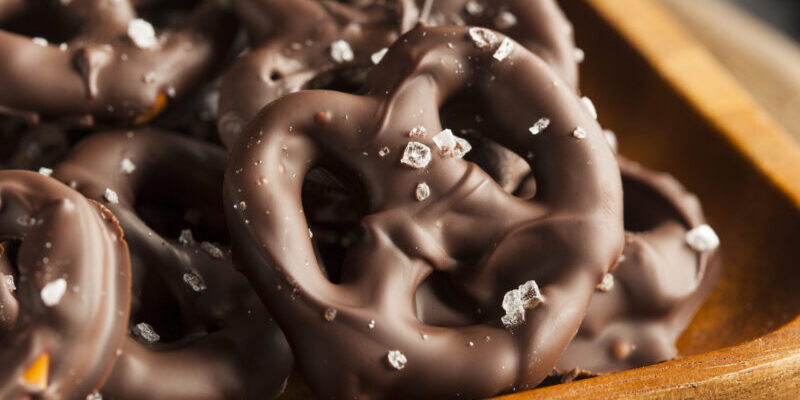
Enrobing is a process used in the food industry to coat baked goods with a layer of chocolate, icing, or other coatings. Enrobing gives the baked goods a smooth, even surface and adds to the overall appearance and taste of the product. In industrial bakeries, enrobing can be a critical part of the production process, and highly specialized machinery and technological solutions are used to ensure quality and consistent results.
The enrobing process typically involves three stages: pre-treatment, enrobing, and cooling. In the pre-treatment stage, the baked goods are prepared for enrobing. This can involve trimming, slicing, or shaping the baked goods to achieve the desired size and shape. The baked goods are also often heated or chilled to achieve the optimal temperature for enrobing.
In the enrobing stage, the baked goods are coated with the desired coating. This can be done using a variety of methods, including curtain coating, roller coating, and spray coating. Curtain coating involves the use of a curtain of chocolate or other coating that falls over the baked goods, covering them completely. Roller coating involves the use of a series of rollers that coat the product with the desired coating. Spray coating involves the use of a nozzle that sprays the coating onto the goods.
In industrial bakeries, specialized machinery is used to automate the enrobing process. An enrobing line typically consists of a conveyor belt that moves the baked goods through the pre-treatment, enrobing, and cooling stages.
Enrobing lines can be customized to meet the specific needs of different products. For example, some enrobing lines are designed for coating chocolate bars, while others are designed for coating biscuits or cakes. Lines can also be designed to accommodate different types of coatings, such as chocolate, fondant, or icing.
Another type of machinery used in the enrobing process is the tempering machine. Tempering is a critical step in the chocolate enrobing process, as it ensures that the chocolate coating is smooth, glossy, and has a good snap. Tempering machines use a combination of heating, cooling, and agitation to control the temperature of the chocolate and ensure that the cocoa butter in the chocolate is in the correct crystalline form.
Continuous tempering machines use a continuous flow of chocolate that is heated and cooled in a series of stages. The chocolate is then agitated to ensure that the cocoa butter crystals are evenly distributed, creating a smooth and glossy coating.
In complex operations, computerized controls are used to monitor and control the temperature flow rate, and thickness of the coating. These controls can be used to ensure that the coating is consistent across all the baked goods, and that the final product meets the desired quality standards.
Challenges
Enrobing baked goods can present a number of challenges that bakers need to be aware of in order to achieve consistent and high-quality results. One of the main challenges is water migration, which can occur when the coating is applied to baked goods that have a high moisture content. This can lead to a soft or sticky coating, and can cause the baked goods to spoil more quickly.
To prevent water migration, bakers can take several steps. One approach is to use a barrier layer between the baked goods and the coating. This layer can be a thin layer of fat-based icing or a layer of fondant. These materials act as a barrier to prevent moisture from migrating from the baked goods to the coating.
Another approach to preventing water migration is to reduce the moisture content of the baked goods themselves. This can be done by using ingredients that are lower in moisture, such as dried fruits or nuts, or by baking the goods for a longer period of time to drive off moisture.
Obtaining consistent results is another challenge when enrobing baked goods. Consistency is important in order to achieve a uniform appearance and texture, as well as a consistent flavor. One factor that can affect consistency is the temperature of the coating. If the coating is too warm, it can be too thin or runny, and if it is too cool, it can be too thick or difficult to work with. Bakers can use temperature controls and monitoring systems to ensure that the coating is at the correct temperature throughout the enrobing process.
Bakers can also adjust the viscosity of the coating by adding thickeners or thinners as needed, or by using different coating formulations for different products.
In addition, bakers can use different types of coatings to achieve different textures and flavors. For example, a fondant coating can provide a smooth, creamy texture, while a chocolate coating can provide a rich, indulgent flavor. Bakers can experiment with different coatings to achieve the desired flavor and texture profile for their products.
You can read the rest of this article in the Spring issue of Asia Pacific Baker & Biscuit, which you can access by clicking here.