
Conveying Systems Deliver Precision
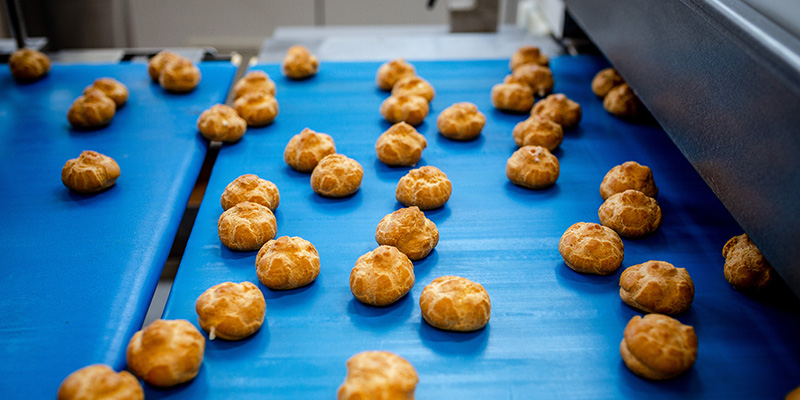
Food-based applications often call for conveyors to run at various speeds throughout food processing and packaging. The key to successfully coordinating the conveyors’ changing speeds is to properly integrate them into the entire processing and/or packaging line early in the design process.
A successful project requires thorough understanding of all the variables that are involved a processing line. To do that, one needs to look at the whole picture, and know what’s happening to the product before it arrives at the conveyor, as well as its destination after it leaves the conveyor.
Another critical component in conveying bakery goods or confectionary items is successfully transferring them on and off the conveyor.
European Baker & Biscuit reached out to some of the major conveying equipment specialists to gain insight into the features that are most important for bakery professionals and the design choices that set apart the available options on the market.
According to equipment manufacturer Dorner, the type of conveyor needed really is determined by the application and what is being moved. The best solution, of course, would be the one that balances gentle product handling, hygienic design, operator safety, and total cost of ownership. “Dorner custom manufactures all its conveyor systems to bakers’ exact specifications. If the application does involve multi-lane conveyance, Dorner will design a system that delivers the functional performance and operational flexibility bakers need when running lines that produce multiple products or the same product in multiple formats,” says Stacy Johnson, Dorner’s director of marketing and strategic planning.
Protecting the Product
Choosing a belt type depends not only on the process, but also on the specific product that needs to be conveyed. Soft products require tighter surfaces for support while baked or packaged products can be conveyed successfully on more open meshes.
“Ashworth offers multiple solutions to address movement of product on a conveyor belt. Our belts can be fitted with guard edges, to prevent product from falling off the belt edges, or flights (to prevent product from sliding on inclines/declines), lane dividers (to keep product in separate lanes) and our PosiDrive Spiral™ system is designed to minimize product movement and maintain product registration throughout the spiral belt path,” says Jonathan Lasecki, director of engineering, Ashworth Bros., Inc.
Heights, Drops and Damage
Another way to guard against product sliding or rolling is to make sure that conveyor speeds are matched with the speed of equipment adjacent to the conveyor. Belts that run faster or slower than adjacent equipment can result in product being dragged off of or forced onto the adjacent equipment. In order to eliminate this issue the system needs to avoid transitions where product is exposed to a shearing action by the adjacent operation running in a different direction than the conveyor.
The type of belt used can also minimize rolling or sliding issues. Factors such as temperature of the application, surface layer material and friction level, among other things, all need to be considered in matching the right belt for the specific food-focused application. High friction or cleated belts are popular choices within the bakery processing and packaging industry.
Trevor Howard, managing director, Fabcon Food Systems also points out that equipment design needs to account for the most fragile products or where seasoning drop-off between conveyors is an issue:
“This can often be made possible by using our long HM conveyors with gates feeding multiple weighing and packaging stations – as opposed to using multiple, shorter conveyors over the same distance. Our conveyors can be up to 30 meters long with a single drive with supports at every four meters. Most height changes tend to be upwards, but downwards changes are made as smooth as possible through the use of chutes and controlled handling.”
Berndorf‘s Dominik Inschlag, sales manager Europe, believes a problem solver for this parameter could be Berndorf’s belt tracking systems, which are constantly monitoring the belt and immediately correcting it, if required. “Parts of the portfolio are simple belt tracking rolls, which can easily be applied afterwards on any type of conveyor.”
You can read the rest of this article in the January/February Issue of European Baker & Biscuit magazine, which you can access by clicking here.