
Mintel: Consumers Eat Chocolate to Boost Their Mood and to Relieve Stress

A new research from Mintel reveals that over one third (38 per cent) of chocolate eaters in the UK say that the emotional benefits of chocolate outweigh any health concerns.
More than that – 24 per cent of Brits say that they have bought chocolate confectionery in the last 3 months to boost their mood, whilst 16 per cent have purchased the treat to get an energy boost.
Other European consumers value the psychological merits of the treat. Half (49 per cent) of Polish chocolate eaters say they eat chocolate to lift their mood, followed by 40 per cent in Italy, 39 per cent in Germany, 27 per cent in Spain, and 15 per cent in France. What’s more, two in five (41 per cent) German chocolate eaters say they eat the treat because it relaxes them, followed by 37 per cent in France, 28 per cent in Italy, 27 per cent in Spain and 23 per cent in Poland.
A healthy treat
Furthermore, Mintel research indicates that, perhaps as a result of its emotional health benefits, a number of consumers across Europe believe chocolate to be beneficial. One quarter (26 per cent) of Spanish chocolate eaters agree that chocolate is healthy, followed by 21 per cent in Poland, 20 per cent if France and 19 per cent in Italy. However, it seems German consumers are more sceptical, as just 9 per cent agree that chocolate is healthy.
And whilst European consumers express beliefs in eating chocolate as an emotional remedy, it comes as no surprise perhaps that the majority of the world’s biggest chocolate eaters are in Europe. 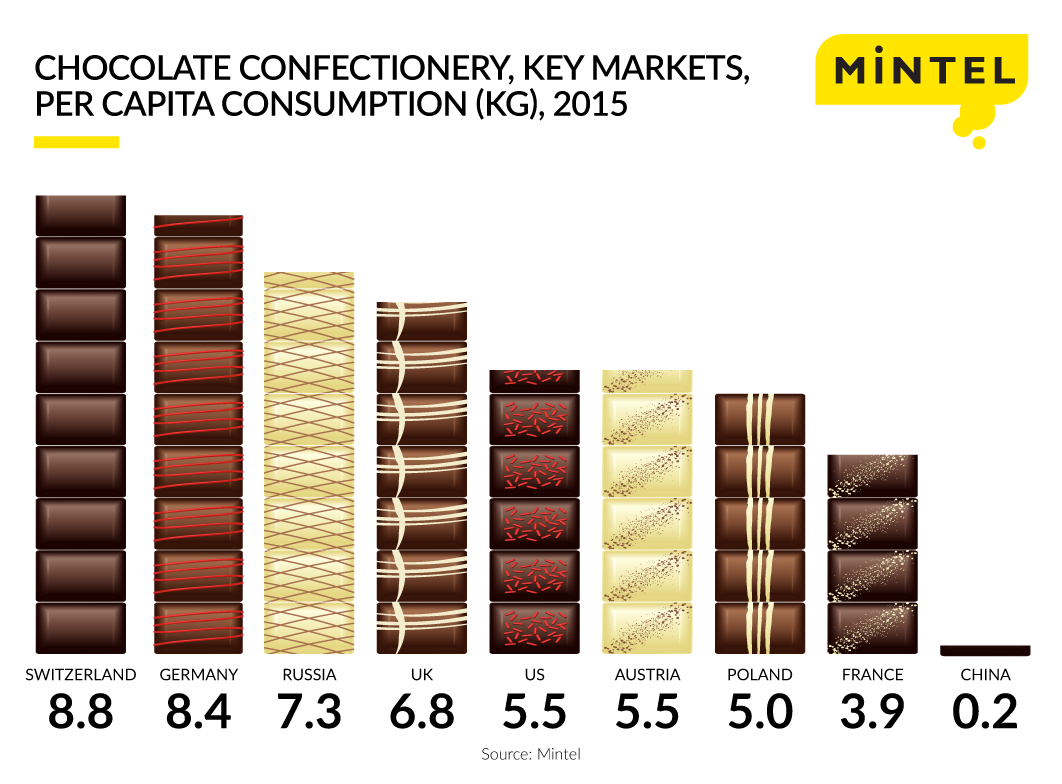
Whilst Switzerland tops the leaderboard, with each Swiss consumer estimated to have eaten 8.8 kg of chocolate in 2015, this is followed by Germany (8.4 kg per capita), Russia (7.3 kg per capita), the UK (6.8 kg per capita), Austria (5.5 kg per capita) and the US (5.5 kg per capita). In comparison, consumers in China are estimated to have eaten just 0.2 kg each in 2015.
But it’s not only in Europe that consumers believe in chocolate’s healing qualities. Across the pond in the US 29 per cent of chocolate candy eaters say that they eat the treat to improve their mood. And in China, where volume sales increased 6 per cent between 2014 and 2015, three quarters (76 per cent) of consumers that eat chocolate agree the eating the treat is good for lifting the mood and 64 per cent agree that eating chocolate is an effective way to relieve stress.
Marcia Mogelonsky, Director of Insight at Mintel, said: “While chocolate confectionery may be considered to be a ‘guilty pleasure’, it is also a food that is strongly tied to emotional needs. This is likely the reason that consumers allow themselves to indulge in chocolate and other less healthy snacks. Even at a time when the importance of healthy snacking is being emphasized, the importance of chocolate confectionery as a psychological wellness tool cannot be ignored.”
In many markets sales are booming, and Mintel research shows that there is more ‘better quality’ chocolate on offer than ever before. Between 2011 and 2015, there was a 72 per cent increase in the number of premium chocolate products launched globally, with 7 per cent of chocolate products launched in 2015 carrying a premium claim, up from just 5 per cent in 2011.
And it seems that this growth in launch activity follows strong consumer demand for quality chocolate. Approaching one quarter (22 per cent) of chocolate eaters in France say that a product containing premium ingredients is an important factor when buying chocolate, followed by 21 per cent in Italy, 17 per cent in Spain, 11 per cent in Germany and 9 per cent in Poland. What’s more, one quarter (25 per cent) of chocolate buyers in the UK say they would be willing to pay more for a luxury brand of chocolate for themselves, whilst 44 per cent would be willing to pay more when buying as a gift.
“Given the extent to which consumers’ food knowledge has grown over the past decade, it is not surprising that they increasingly demand unique products that come with a stamp of authenticity. This is especially notable in chocolate confectionery, as consumers become more interested in cocoa sourcing, cocoa content and premium positioning.” Marcia adds.
Mintel research reveals that in Europe taste buds have a craving for dark chocolate. In 2015, 48 per cent of Italian chocolate eaters said they looked for dark chocolate when buying the treat, up from 36 per cent in 2012, with the same trend seen in France, (48 per cent in 2015 v. 39 per cent in 2012), Germany (30 per cent in 2015 v. 24 per cent in 2012) and Spain (40 per cent in 2014 v. 36 per cent in 2012).
Looking for innovation
Chocolate eaters around the world are looking for more innovative flavors, and the industry is responding. Notably, between 2011 and 2015 there was a 140 per cent increase in the number of chocolate products launched globally flavored with matcha tea. What’s more, in the same time period, there was a 270 per cent increase in the number of chocolate confectionery products launched with a salt, or salted flavor.
Today, 44 per cent of chocolate buyers in the UK say they’re prompted to buy chocolate when they see new flavors in-store, whilst 21 per cent of chocolate candy buyers in the US say they usually buy new types of the treat when they see them.
“The growing influence of Asia as a source of inspiration continues to be seen in the chocolate industry. In 2012, wasabi was the ‘Asian flavor of note’ in chocolate confectionery. In 2015, matcha green tea took its place. Chocolate manufacturers are exploring the use of teas as an ingredient in confectionery, both because of the health benefits they claim and because of their flavor notes, which can complement different strengths of cocoa. While matcha is the best known right now, it is possible that other teas will gain attention and grow in popularity as chocolate confectionery flavors and ingredients as more research about their health benefits comes to light.” Marcia concludes.